Blogged articles
Yosha's Crying Wall
Sporadic jottings on the fly
By William Wetherall
First posted 13 July 2009
Last updated 8 February 2026
|
Old blog articles on Original Yosha's Crying Wall |
2009-07 |
Social cybernetics
All this talk about how corporations are hooking kids By William Wetherall13 July 2009 I had similar thoughts when my son began spending most of his time with a home video game he had to have because all his friends had one. My dad felt this way about my generation, which seemed to be watching too much TV and reading too many comics for its own good, to say nothing of rock'n'roll. It all began with the ancestors of the shamans, medicine men, and priests. Vocationally specialized fish-hook, blow-dart, and arrow-head makers also share the blame. Then came itinerant snake-oil vendors and local shoe salesmen (where I got my introduction in the art of selling people something they don't need and may not really want) and redundant engineers peddling the latest Star Wars weapons systems. Today the masters of "friendly persuasion" are simply a few degrees removed from the neighborhood and town. Their pitches have become "sophisticated" by behavioral psychology applied to the design, manufacture, and distribution of addictive consumer goods. The theory, knowhow, and tools needed to market the "stuff" that globally courses the veins of human vanity are so elaborate that only a handful of people understand how they really work. The rest of us, as passive participants in the slow but gradual industrial slogging and social blogging of the earth, are the meek who shall inherit its ruins. A lot of writers in the late 1800s and early 1900s forecast the Brave New World doom of humankind with the coming of telegraphy, telephony, radio, and television. Rooms full of vacuum tubes and gear trains shrunk to pinhead nanosecond microprocessors in the span of half a century. In the meantime, Vance Packard (The Hidden Persuaders), Norbert Weiner (God and Golem), Arthur Koestler (The Ghost in the Machine), and a host of other such writers saw where it was going after it had become impossible to deny that it had begun. Today the ideological drive is toward the globalization of everything from machine-readable passport standards to local ballots. Still, the advances in electronics, and in the materials science that has made today's virtually unbreakable wireless technology possible -- not to mention the programming that instantly gratifies HAL's appetite for more complex code and content control -- have been startling. Just the other day a friend called my conventional cordless phone from his conventional cordless phone on the other side of the planet. Or at least I took the mere stream of electrons exciting the wafer of plastic replicating his speech in the air outside my ear for his living voice. He reiterated his chronic fears about the quality of life in this age of cells, telecommuting, and virtual pets, fast food and junk politics. And immediately after he ended this thread of critique, just before he rang off -- or did he hang up or press off? -- he, a music lover, complained he had lost his terabyte iPod on which he carried every cacophonic symphony ever composed. 23 March 2009 Dreams of happiness
Neither the United States nor Japan 15 July 2009 By William WetherallThe Declaration of Independence of 4 July 1776 holds that "all men are created equal, that they are endowed by their Creator with certain unalienable Rights, that among these are Life, Liberty and the pursuit of Happiness." Too bad for the fishes in the deep blue sea. The American scientist, diplomat, and publisher Benjamin Franklin (1706-1790), one of the originators and signers of the declaration, is supposed to have remarked that the U.S. Constitution guarantees only the pursuit of happiness. Individuals have to catch up with it themselves. William Channing (1780-1842), a Unitarian minister and social critic, similarly maintained that "The office of government is not to confer happiness, but to give men opportunity to work out happiness for themselves." "Created equal" is taken in context to mean that all people were born with what Thomas Jefferson (1743-1826) more often called "natural rights". Apparently he preferred "inalienable" to "unalienable", but his style sheet was trumped by a typesetter who was inperturbed by unalienable. It could not have a typo of the kind made today on a qwertyui keyboard. Japanese equivalents of the word "happiness" do not appear in the 604 "Constitution in Seventeen Articles"(十七条憲法)by Sh?toku Taishi (573-621). Nor do any show up in the 1890 Meiji Constitution. The English version of the 1947 Constitution of Japan, though, embodies verbatim the famous phrasing of the Declaration of Independence. Article 13 第13条 Japan's postwar Constitution was based on a draft in English submitted to the Japanese government by the Allied Powers represented by Douglas MacArthur (1880-1964), then a general, now a god. The Allies didn't get everything they wanted, but the Imperial Diet found the guarantee of a "right to life, liberty, and the pursuit of happiness" harmless enough. The dignity of the individual had, after all, been subordinated to "public welfare". Besides, people in Japan past and present, like people in all places at all times, have always been free to pursue happiness to the extent that no one in a position of authority has found reason to stop them. Essentially, then, nothing has changed. If you're not happy, it's your own fault. If you're not where you want to be, it's up to you to get there. Or try to get there. Or be content with a dream of getting there. I said as much to a friend who insists on crying once or twice a day mostly out of self-pity. I tell her, if she's not doing what she wants to do, then do it. Maybe she can't "Just do it" as the Nike ad urges. Perhaps she will need to do a little preparation -- study, train, practice, save money, whatever. Nothing, though, is going to change unless she strives to make things change. Since she can't afford to hire palanquin bearers or a helicopter, the only way she's going to get to the top of Mt. Fuji is to hike there on her own two feet. Still, you may go through life, working and struggling to make your dreams come true, and never get close to reaching your goals. Would this mean that happiness has evaded you? Not if you accept the dictum that happiness is in the pursuit, not the arrival. Of course you may feel a wonderful sense of accomplishment when at last you reach the top of Mt. Fuji and look down on the rest of the world. Yet you might stumble all the way to the summit and find yourself shrouded in a fog so thick you can't even see into the crater. While you could not be blamed for feeling disappointed, you have every right to take joy in the fact that you not only dreamed of climbing Fuji, but actually did. Life is a marathon. Only one person is going to win. A few others will place. Many, but not all starters, will finish. Many times more people will be content to mingle along the route and just root. The vast majority of humankind won't even know about the event, or care if they do. As long as you have the legs to carry you down whichever road in the wood you choose to take, there will be nothing to stop you except an occasional tree across your way, or a perhaps a mountain lion. Barriers and dangers are there to discover ways around. At times you may encounter an obstacle so high, wide, and deep, or so terrifying, that you simply have to admit you've reached a limit. Accepting a limitation is not giving up. It is merely a recognition of the difference between a possible and an impossible dream. Some people without legs find ways to run. Many people with legs entertain an intent but never make an attempt. The unfortunate are those who have no dreams. The most fortunate are those who cherish both impossible and possible dreams. The possible dreams are for achieving. The impossible dreams are for embracing in your heart, from which they will nourish the sparkle in your eyes that others will see as your soul. One way or other, we all cross the finish line of life. But how will we get there? Running? Crawling? Lying on a gurney? Or slumping in a catatonic state before a boob tube we didn't turn on and can't turn off? Now and then you read about a man or a woman dying on the slopes of Mt. Fuji from a heart attack. Some people climb even knowing the risks. They are among the lucky few who realize that happiness and comfort are not the same thing -- and that "inalienable rights" do not exist except as we imagine and earn them. 3 January 1999 Race across Pacific
My latest nightmare begins By William Wetherall17 July 2009 I'm with my two kids, and we're on our way to their grandfolks' home in the Sierras. The plane goes down in the bay, and the three of us end up on autopsy tables to be IDed. A medical examiner looks at my daughter and writes "Asian" in the race box. My son's post mortem officer decides he's "White". I'm declared "African American" by a coroner who thinks I look like Ed Bradley. As I'm gurneyed back to the fridge, I smile. What would they have said about Tiger Woods? Then I laugh at the thought of a panel of government demographers, educators, criminologists, and health officials defending the accuracy of race statistics. A few years back, a Seattle couple actually called one of their racially mixed children "Asian" and the other "Caucasian", in order to satisfy race quotas at the schools of their choice. "Situational identity" I call it. But what else are racially ambiguous people to do when faced with the rigidities of identity politics? Two years back, a man at San Francisco International Airport did, in fact, do a double take on me and ask, "Aren't you on sixty minutes?" His grammar puzzled me, but he seemed sober, so I smiled and said, "The Sacramento flight's been delayed an hour." His face flushed as he said, "I'm sorry, I thought you were someone I saw on TV." When I told my folks about this encounter my dad laughed and said, "You do look like Ed Bradley." "Ed who?" I said. Cultural literacy is the first thing to go when you live abroad as long as I have. My dad told me about "60 Minutes" and we watched it that night. I felt honored. "So we've been passing?" I said. "Not that I know of," my dad said. "You played Pocahontas once," my mom interjected. It was long ago when I was a boy. Everyone thought I looked the part. Much later in life, I happened to remark to a professor of Asian American Studies that my mother was born and raised on Nez Perce lands in Idaho. "Are you a Native American?", she asked, her face lighting up. "They were homesteaders," I said. Her smile vanished. The absurdities of racializing human beings, past or present, are not always funny. In the end, one has to question the moral sanity of a government that has become increasing obsessed with racial compartmentalization and labels. The "white"/"non-white" dichotomy of yesteryear was bad enough. The elaboration of "colored" into half a dozen or more other arbitrary categories has added trendy insult to historical injury. My problem with race stems from the debates I have had defending the need for racial and ethnic data in medical research. I am, after all, a social scientist of sorts, with an impulse to quantify the human condition. I recognize the genetic and cultural diversity of the human species, and I acknowledge the role that genes and even culture can play in disease. Yet I keenly feel the moral dilemma of racializing individuals as a matter of public policy. I was glad to see the religion boxes go before I left the United States. And I have come to appreciate not seeing a single race box in nearly thirty years of life in Japan. Though I grew up taking race boxes for granted, now I find myself disgusted by the sort of questions my children have to face when in the United States. Beyond voluntary participation in research that requires disclosure of family ancestry, I can find no justification for differentiating people on the basis of their genes or culture. The race box choices are "so weird" as my daughter once put it. "What's this, Dad?" she asked on a visit to California, tapping her pen on the "Race and Ethnicity" section of an application form. "Just cross it out," I said, not wanting to talk about it. "But what's it mean?" my son, beside her, persisted. "They want to know what you are. Your race, your culture, things like that." "I'm half." "That's what some people call you, yes. But what are you? Really?" "In Japan I'm Japanese. Here I'm an American." "Because you're a citizen of both. What else are you?" My daughter thought a moment and said, "I'm just me." "Do you see a 'Just me' on the form?" "No." "Then cross it out." "Can you do that?" "Watch" I said. I drew a big X through the whole section and smiled when my son went "Wow!" My kids get a kick out of some of my antics, but they worry. They've been well trained in Japan to follow bureaucratic instructions -- whereas their old man has a history of civil disobedience on both Pacific shores. The next time they see a race box, though, I'm betting they'll make me proud. As submitted to the San Francisco Chronicle for its "Guest Forum" column, and acknowledged, on 7 June 2002. It was not published. 15 July 2009 Lost in translation
A menage a trois between bureaucrats, scholars, and lawyers By William Wetherall18 July 2009 The movement to standardize translations of Japanese laws began with a government task force in 2004. Version 1.0 of Standard Bilingual Dictionary (SBD) was released in 2005. Government agencies began cooperating in the development of a foundation for promoting standardization of foreign language translations in 2006. The Ministry of Justice took over the project in 2009. Since 1 April 2009, the Ministry of Justice has been responsible for continuing to develop the dictionary and for overseeing the translation of Japanese laws in accordance with its standards of usage. The government's aim is to improve the quality of legal information it globally disseminates in other languages. The Nationality Law, as revised in 2008 effective from 2009, was translated with version 3.0 of SBD in May and posted in July 2009. It is a disaster, as are some of the other translations now available through the "Japanese Law Translation Database System" (JLTDS). 日本法令外国語訳データベースシステム JLT website disclaimersThe "Japanese Law Translation" (JLT) website appropriately reminds visitors that its translations are "unofficial" and only original Japanese texts of the laws have authority. It also makes these disclaimers. I use the plural because the Japanese and English versions are significantly different (retrieved 8 July 2009, emphasis added). このページの利用に伴って発生した問題について、一切の責任を負いかねますので、法律上の問題に関しては、官報に掲載された日本語の法令を参照してください。 The Government of Japan shall not be responsible for the accuracy, reliability or currency of the legislative material provided in this website, or for any consequence resulting from use of the information in this website. For all purposes of interpreting and applying law to any legal issue or dispute, users should consult the original Japanese texts published in the Official Gazette. So much for the government's pretense of wanting to improve quality and understanding through the "standardization" of legal translation. The Government of Japan, represented here by the Ministry of Justice, will spend tax money developing its elaborate dictionaries and databases -- and crank out translations as fast as its technocrats can run the software -- yet baldly refuse to be accountable for "the accuracy, reliability, or currency" of its work. The Japanese version of the disclaimer says nothing about the government not taking responsibility for "the accuracy, reliability or currency of the legislative material provided in this website." But since the disclaimers are legal statements -- and since both declare that only Japanese versions of laws are authoritative -- it would appear that the government could, in fact, be held accountable for its irresponsible linguistics standards. 20 July 2009 Internet hunting
The wild woolly web is a cornucopia of forums By William Wetherall24 July 2009 Internet bulletin boards existed long before the high-powered servers, terminals, and software that now link everyone with a personal computer or mobile phone -- at speeds imaginable only to sci fi fanatics in the dial-up modem days. In the good ol' days, the boards may have been tamer -- if only because so much emotional energy was expended just typing the commands it took to get on line, stay there, and say your two-bits worth in as few costly metered seconds as possible. All manner of forums, mild and vulgar, thrive today -- despite the spread of social networking and messaging sites like Facebook and Twitter. Not a few people continue to be interested in -- or obsessed with -- the themes they define in a thread in a string in a rope in a choking hawser. Some bulletin boards are labyrinths in which a casual visitor will quickly get lost in the tangle of twine. Older, colder threads get bumped to make more memory and bandwidth available to newer, hotter threads. Search site archives are stuffed with dated and even deleted threads. Some boards permit total anonymity in order to encourage virtually risk-less participation. This may invite abuse, but it also allows some people to get downer and dirtier than they would if they thought a reader might know who they were. Communities formed around such virtual anonymity nonetheless constitute actual social entities which gather the mass and velocity that define the vectors of one or another version of truth, urban legend, conspiracy theory, or defamation movement. Strategically directed, the collective momentum can have considerable impact. Stalking gameBulletin boarders with hunting instincts, on the same or different boards, are known to pack like wolves and coyotes when going after a bison or deer. The self-appointed hunters do not carry, much less fire, their own rifles with laser scopes. They get others -- politicians and corporations -- to do the wet work. Internet hunters work like a team in the Combat Information Center of a warship. They spot other vessels and aircraft with their search radars and sonars and identify them as friend or foe. If an enemy they will decide its threat and whether it should be killed. If the enemy is to be killed, its coordinates and movements will be fed to a weapons system. When the target has been engaged, someone will order others to push the buttons that fire the rounds, torpedoes, or missiles that destroy it. Internet hunters stalk their prey in Google, track down every bit and byte of information they can find, the more damaging the better, and publicize it, with their allegations, on the highest profile boards. Covering their digital footprints every step of the way, they will send the data to organizations and individuals they think will have both the motivation and power to kill the prey in their stead. Having put the wolves on the scent of their prey, the hunters will wait, listen, and watch. They will hear media reports of the wolves howling. On the news one night, they will catch a clip showing the wolves chase, tire, and strike the prey. The scandal will precipitate an apology, a firing, a resignation, a divorce, a suicide. As their main object was to see their prey destroyed, most Internet hunters will abandon its carcass and spend the rest of their life telling tales of the great hunt on the boards and to their grandkids. A few will download and save files of their postings as trophies of their bravery. Boards are generally just soapboxes. Some are stages for flaming or outing. Others are venues for postings that blatantly overstep the line between fair criticism and libelous ad hominem slander. Victims are lining up to file lawsuits. More attorneys are specializing in claims against Internet service providers. Some courts have awarded plaintiffs damages and ordered offensive content deleted. Public squareInternet forums are tantamount to bulletin boards in laundromats. What you post can get you negative attention from law enforcement officers. Advocating that someone should be assassinated -- or expressing "hate" against any group, even in the form of, say, denying or doubting the German "Holocaust" of Jews in Europe or the Japanese "Rape" of Nanjing in China -- are causes, in some jurisdictions, for investigation, arrest, prosecution, and punishment if found guilty. Many website administrators now monitor, or filter, content that might invite unwanted public outcry or legal action. Mostly, though, the World Wide Web has become an unmonitored, unfiltered forum for free speech, like or not what others say. The Internet facilitated the mass contribution of funds and other forms of support that brought Barack Obama to the White House. It will undoubtedly also foil China's attempt to protect itself behind a Bamboo Firewall. 24 July 2009 Reflected glory
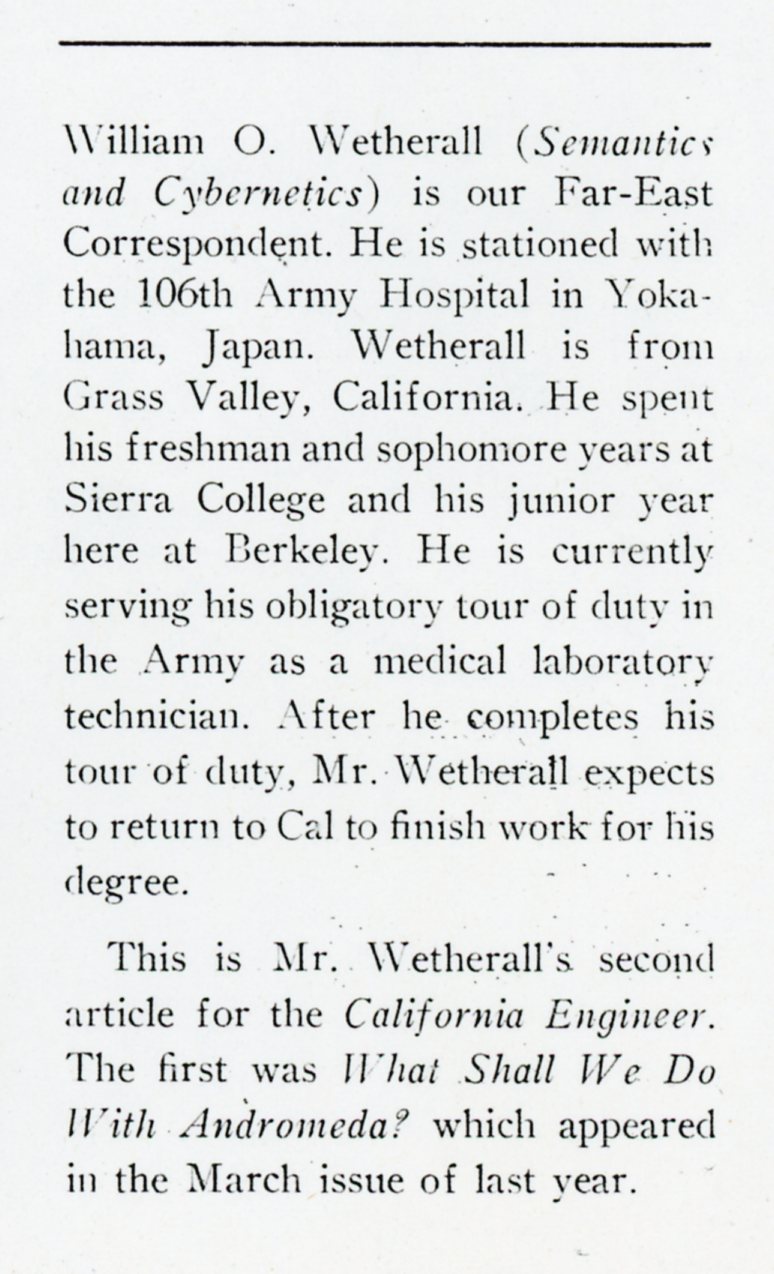
The other day I stumbled across my name By William Wetherall28 July 2009 Some threads of the forum were dominated by activists who follow the needles of one or another ideological compass in their pursuit of happiness. Posters to the thread in which my name appeared were engaged in speculation about contributors to the scandalized (now gone) WaiWai feature of the (now mostly gone) Daily Mainichi News. One poster linked my name with some lawsuits concerning my children and Japan's Nationality Law between 1978 and 1988. The writer was under the impression the cases were related to revisions that became effective from 1985. I contended, even then, that the law was being revised despite the litigation. Another poster connected me with a translation of Oe Kenzaburo's A Quiet Life, and also profiled the person with whom I collaborated on the translation. The poster, who appears to have traced our backgrounds on Google, failed to say I had previously published a translation of one of Oe's short stories and an essay about Oe -- and that the principal translator of the novel is a good friend of Oe's. I was also tied with Doi Takako. A House of Representatives parliamentarian when the nationality cases were in court, she staunchly argued that a child born to a Japanese woman married to an alien should have the same right to acquire Japanese nationality as one fathered by a Japanese man whatever the mother's nationality. Apparently the poster had not discovered that a newspaper columnist at the time had mentioned my name in the same front-page article in which he dropped Doi's name. The connection of stale dots in the thread was not, however, about me but others I was alleged to know. Thanks to the manner in which the thread publicized the Google-retrieved revelation that we had crossed paths, they too may be said to have crossed paths with the likes of Doi and Oe, neither of whom I have ever met -- but neither have I met Will Smith except on the big screen. Now imagine all the people that Oe and Doi -- he a winner of the Nobel Prize for Literature, she arguably the best-known woman in late 20th-century Japanese politics -- have met somewhere. Imagine all the people -- famous, notorious, anonymous -- whose sweaty palms these two celebrities have pressed in the course of their public and private travels and travails. Did I mention that my dad got Babe Ruth's autograph? I might complain that Internet wolves have too much time on their hands. But they could say the same about me as I write this blog. My dad also has a doubly signed color portrait of Barak and Michelle on his bathroom counter. The Internet has become a village square, a community well, a public bath (and, let's face it, latrine). Everyone gathers there to spread the latest rumors about local and world affairs. Before I forget, I ought to confess that I spotted Adlai Stevenson II (1900-1965) from my dad's shoulders one afternoon in Golden Gate Park. Marshall McLuhan (1911-1980) -- the man to read in the 1960s when I published a couple of essays called "What Shall We Do With Andromeda?" (1965) and "Cybernetics and Semantics" (1966) -- had that much right, among a few other predictions that have turned out to be mostly true. "Six degrees of separation" is also turning out to be more urban than myth. May everyone caught in the webs of gossipy Internet threads take a deep breath and bask in their fifteen nanoseconds of fame. 28 July 2009 Disclosure 1 I wrote a few articles for WaiWai. They have been posted for many years, and remain entirely public, on my Yosha Bunko website. Disclosure 2 My dad is pushing 100. He still drives, shops, cooks, tends large flower and vegetable gardens, walks in the woods, writes inspirational stories, practices law -- and mentions Ruth and Stevenson during the interludes in his praise for the Obamas. |
2009-08 |
Mumbly pegThere was a time when you couldn't be a boy without a pocket knife. By William Wetherall1 August 2009 I still have the Case knife I carried around in high school. Its two identical blades, one on each end, fold out from the middle. Each is about 6.5 centimeters or roughly 2.5 inches. Their edges will cut small limbs, and their points will stick in trees and of course sod. The knife now sits in a small black lacquer tray in a recess in the wall of the vestibule of my home, where you step up into the hall after taking off your shoes. Sharing the tray are a pair of glasses, two screw drivers, needlenose pliers, the chop I use on receipts for registered mail and packages, and a pedometer with a chronometer. I now use the knife mostly in the garden when I'm too lazy to get out the pruning scissors. At one time it was mainly used to cut the thick plastic straps that sealed the mail sacks of books that no longer come from the United States. I would whip it out and have the sacks open before the postman could unholster his cutter. I also have a fairly modest Swiss Army knife. It has a large blade, a smaller blade, a can opener with a small screwdriver, a bottle opener with a large screwdriver and a wire stripper, a saw, a reamer, a corkscrew, scissors, tweezers, a toothpick, and a lifetime warranty that doesn't say which or whose life. The saw could fell a tree or amputate a leg. Even the tweezers could be turned into a weapon of mass destruction. The Swiss Army knife does not have a USB memory stick, but it does have a keyring to which I have anchored a thick lanyard. I used to tie the lanyard to a belt loop on my jeans when carrying the knife in my pocket, but no more. The knife, with the lanyard, now rides in the bottom of the pouch on the back of my pack sack with a flashlight, radio, chopsticks, bronchodilator spray, and a zillion other things that will come in handy when the Big One comes, the train derails, and I have to break my way out of the wreckage and hoof it through the urban and suburban rubble and ford a couple of rivers and cross fields and hills back to what remains of my home, where a one-month supply of All Bran, trail mix, and bottled water awaits me. One time, on my way in Narita airport to board a Malaysia Airlines flight to Los Angeles, the Swiss Army knife, in the pack sack where I had carried it on a number of previous flights, caused a commotion among the security staff. The man in charge decided I could not carry the knife on board. Someone put it in a bag, filled out a form, gave me a copy, said I could pick up the knife in LA, and advised that in the future I put it in my check-in baggage. That was a decade before 9/11. Now it's hard to carry even yourself on board. My pocket knives have been only marginally legal in Japan. Possessing them is not a problem. Their longest blades slightly exceed the legal length limit for double-edged blades, but they are single-edged. The problem is carrying them around in public, unless you are going fishing or hiking. And you don't want to argue finer points of law, even with your local koban officers, however friendly, however well they may know you from previous offenses like roadside pissing and grinning to yourself. My son also has a Swiss Army knife and he, too, is careful not to carry his in public. He is thinking of buying one of the new gadgets that has all manner of foldout tools but nothing that would cut or pierce. It too would be illegal on a plane but he could carry it around and flash it at the cops. One time, when I was teaching, I brought my double-blade Case to school. We were having an outing that day in a nearby park. Everyone had to do a show-and-tell, and mine was about the knife. I said I had brought it because there were snakes, and when the girls stop shrieking, I showed them how to do mumbly peg. That day on a spot of grass, the sun flashing on parts that had not rusted, I put my trusty Case through its paces. I showed them all the feats I could remember of the game I had played countless afternoons on neighborhood lawns in the Sunset District of San Francisco. They were more amused by my shouts of joy when the blade stuck at least two fingers off the grass, than by my flips of the knife. They could not believe that I and most of my friends had carried pocket knives from the time we were in elementary school, when many of us were Cub Scouts. To class. In the play yard. Human civilization lost its innocence many millennia ago. But children, boys and girls, have lost their innocence within my lifetime -- at least regarding knives. The main complaint of older adults in Japan is that children no longer learn to shave pencils and skin apples. My complaint is that no one is learning to play mumbly peg. 1 September 2009 Garbage watchRights and duties of citizenship come in various bags. By William Wetherall12 August 2009 My main duty, this hottest time of year, has been to protect kitchen garbage from crows, stray dogs and cats, and homeless people too weak to lift the plastic net I have had to put out three times a week for the past couple of weeks. The net is no barrier for critters small enough to crawl or fly through its holes. My main right has been to vote on a garbage referendum in the neighborhood association which embraces my address -- and which puts me, with my approval, on its garbage watch roster. I am, albeit an alien, a registered resident of the city -- a "citizen" if you will. My status as a municipal resident permits me to participate in the national health insurance and pension schemes, and obliges me to pay national and local taxes. I can't vote for National Diet representatives, or for municipal or prefectural assembly members. But I can cast a ballot for how to manage neighborhood garbage. Neighborhood associationsSome neighborhood associations are involved in public safety, crime prevention, fire prevention, youth counseling, elderly care, child care, disaster preparation and relief, and local festivals. But most associations today, while passively circulating bulletins about municipal facilities and notices of recent burglaries, are mainly concerned about keeping their streets and parks clean and safe for kids, and with garbage collection. Garbage collection is the main activity of my association. In most neighborhoods, pick-up points are established at a central corner that is also convenient for the garbage trucks. Newcomers to my neighborhood are surprised to find that pick-up points rotate from house to house every couple of months. A couple of houses are not used because they lack adequate frontage on the street -- mine, for one, because my lot is at the end of a narrow 20-meter approach. Or they have suitable frontage but are located in places that would hamper the movements of garbage trucks. Practically all households, though, share weekly garbage duties. Kinds of garbageOn burnable (kitchen and garden) garbage days, the household on watch sets out the net that protects bags of garbage from birds, dogs, and cats. On recycled garbage days the same household sets out the net for bags of plastic garbage (mostly plastic packaging), various bags, a box for batteries, and a vat for cooking oil. One bag is for plastic bottles. Another is for cans. Three others are for clear, amber, and green bottles and jars. Yet another is for miscellaneous unburnable garbage (including broken glass and ceramic pots). Textiles, metal, and several kinds of paper and cardboard are also separated before setting them out. Each household separates its own garbage, with the help of elaborate charts that show various classifications and how waste should be bagged, cut and bundled, whatever. There is only one truck on burnable garbage days but several on recycled garbage days. There is one truck for plastic garbage, another for plastic bottles, another for glass containers, another for cans, another for miscellaneous non-burnable garbage, batteries and light bulbs, and cooking oil, another for metal, another for cloth, another for paper including magazines and books, light cardboard, and waxed cartons (torn or cut open, not just flattened), and another for heavy corrugated cardboard. The specialization makes sense, as there are lots of neighborhoods, and pick-up stations every three or four blocks. What holds us togetherIn the ten years I have lived in my present neighborhood, the only controversy has been the garbage collection system. The pressing issue now is whether to continue to manage our garbage pick-up site ourselves -- or consign its management to the Clean Center -- the municipal organization that oversees garbage collection, dumping, waste management, and resource recycling. The debate is over the comparative merits and demerits of keeping a hand in the management of our own garbage, versus contracting the Clean Center to do everything except separate the garbage and carry it to the collection site. Participation brings the neighborhood association a nominal income as its share of the value the company now realizes from selling recycled resources. Consignment would result in forfeiting this income. The problem is not the money, since there is nothing to use it for. One problem is that, as in many neighborhoods, the number of single-resident homes is increasing, including elderly people who live alone and who may themselves need assistance. The other is that, if the association leaves everything to the company, there is nothing left to keep the neighbors rubbing elbows with each other. Supporters of the status quo argue that, while fewer households may be willing, ready, and able to participate in the garbage system, and while this will impose an increasing burden on those who volunteer for garbage watch, the present system will still provide an opportunity for neighbors to get to know each other in the process of cooperating on managing their garbage site. As one neighbor put it, "Garbage collection is the only thing that holds us together." Well, yes and no. My closest neighborsGarbage site preparation and cleanup is almost always the job of the housewives who are at home most of the time. While the duties are assigned to a household, they are usually performed by the women who stay at home. You rarely see men, or kids, congregate at the garbage site. I have met many of my neighbors but see and talk to some more than others. Sheer proximity, followed by common interests, seem more important than, say, who is in what neighborhood association and where they deposit their garbage. I have still not met the father of the family that lives closest to me. I have met his wife and four children. I have met his parents, who live with them. And now and then I have heard what I take to be his voice. But I have never, to my knowledge, seen him. Our homes are separated by about two meters, and there is no fence between them, which is rather unusual. The main entrance of their home, though, is on its other side. And their household is in a different neighborhood association. Borders, which have to be drawn somewhere, inevitably separate closest neighbors. I regularly see the two women of the house when they come out their kitchen door, at the back of their house, which faces what used to be the front of my house. That is where they keep their garbage until pick-up days in their neighborhood. It is also between our houses that I have given them fresh black berries and tomatoes from my garden, and where they have given me potatoes and boxes of cakes they have picked up on weekend excursions somewhere. Recycled-garbage management questionnaireBut back to my adventures in garbage citizenship. The recent ballot on what to do offered three choices: (1) Continue to manage the garbage site locally, (2) Consign its management to the Clean Center, or (3) Either. The information provided with (2) stated that, at present, some 70 neighborhood associations among about 250 in the city have chosen to consign everything to the Clean Center. That appears to be the trend. You could optionally check a reason for your choice.
I lay awake, these sweltering August nights, not wondering if there really is a Dog, for I know there are many. I hear them barking on one battleground or another throughout the known universe. Rather I dwell on a more fundamental question. Is the regionalization and globalization of garbage collection tearing apart my community? 12 August 2009 Rites of passage
Some you go through everyday in your life without knowing. By William Wetherall16 August 2009 "You've got a couple of blockages that bear watching." Or "It's shot up to 23." Someone with a Japanese dream opened the Nepal/Indian restaurant called Kumari in the shell of a cast-off gas station a ten-minute walk from Toride station in Ibaraki prefecture. That's not as far from Tokyo as it sounds, but it's a long ways from India and Nepal. The place is open only for lunch and dinner. Sorry, no breakfasts, which is too bad, because it was a quarter to eight in the morning and drizzling when I walked by the place on my way to a local hospital. It's a 30-minute walk, but to wait for the next bus would have made me late for the blood draw. Besides, my heart needs the exercise. There's parking for six vehicles, a variety of dishes, a drink-all-you want deal, it's okay to bring kids, and a variety of credit cards are accepted. The meat, boiled in spices, is soft enough to cut with a fork, you can have your curry as hot as you like, and the Nepalese and Japanese staff are cheerful. In all these respects it is a fairly ordinary restaurant, with different lunch and evening menus. Size wise too it's par for the course. The Toride operation -- there's a twin in Asagaya in Suginami ward in Tokyo, which is on the other side of the world from Toride -- seats 26. So if your party has 27, someone will have to stand. The person who is standing can sit when someone goes to the toilet. And the person who goes to the toilet can stand until the next person has to pee. But no will stand for long if everyone's chugging mugs of authentic Himalayan Gorkha Beer. The standing time will be even shorter if the party consists mostly of people with prostatic hyperplasia like me. That's "enlarged prostate" in English. I was on my way to the hospital for a semiannual PSA test to determine if the proliferation of cells that are causing my prostate to swell is benign or malignant. That's "prostate-specific antigen" in doctorspeak. Three years ago, my PSA shot up to 23 from around 2. Doctors were puzzled. I was shocked -- until two weeks later it was down to 10. And six months later it was 7. In another half year it was around 5, and for the next two years it hovered between 4 and 7. What would it be today? Two hours later I was in the doctor's office. Fine, thanks, and you? Had anything changed in my general condition? He pursued that line of questioning for a few minutes. Any new medications? Now that you mention it, two months ago my heart doctor put me on XYZ instead of ABC. The urologist made note, but nothing else, of this fact. "Well," he said, "your PSA has dropped again. It's now between 2 and 3. And there's nothing to suggest that it might be a false low." We talked about the implications and he said I could go a year without another test. That was fine with me. I took the bus back, as by then the sun was out and high, and the temperature and humidity were soaring. I gazed at the Kumari as the bus lumbered by it in the late-morning traffic. I have it on the authority of several web sources that a kumari is a prepubescent girl who embodies the spirit of a certain goddess. Such girls are worshiped in a number of South Asian countries, but particularly in Nepal, by royalty and commoners alike. Apparently the word means "virgin" in Sanskrit, Nepali, and a few other languages in the region. The goddess vacates the girl's body at the onset of menstruation. My anthropological muse tells me such celebrations of a girl's divine possession are communal rites of passage. Who am I to disagree? I was circumcised a couple of days after my birth. It was something done, then, to practically all boys born in practically all American hospitals. I probably tripped over the C word in Bible school, but was well into my teens before I knew what it meant. Someday I may have to submit to a prostate biopsy. It's been a few years since I read Bruno Bettelheim's "Symbolic Wounds: Puberty Rites and the Envious Male". Perhaps it's time to give it another look. 16 August 2009 Polling timeI can't go to the polls but I have the right to be polled. By William Wetherall29 August 2009 Tomorrow's election day and the phone's been ringing more than usual. Half the time it's not for me. "Is your wife there?" I'm often asked by a voice I recognize as that of a telemarketer. It's almost always a woman. No man has ever asked me if my wife was home. Wives are supposed to be home and husbands at work. No one hires men to make calls and ask women who pick up, "Is your husband there?" "Not that I know of," is my usual reply. Which is not to say I don't have a wife, or didn't have one, or wouldn't want one. Simply that, if I did have one, and if she was home, I wasn't aware of her presence -- which might qualify her as a model wife. Most telemarketers say goodbye at this point. A few ask more questions and get similar answers. The most persistent eventually give up. Hopefully they check the "Nut case" box and delete my number from their list. Wrong numbersOther callers are ordinary people who have punched the wrong numbers. One such call resulted in this conversation. "Is Yoshie there?" a man said after some hesitation. "No," I said. The same guy had called just a few minutes before. Then he had said "Oh, I'm sorry" and cut the line after I said "Hello." "You sure?" he said. "No Yoshie here. What number are you calling?" He told me. I told him mine was 2, not 3. He needed to stretch his right thumb a bit more to reach the 3. "I thought you might be a rival," he joked, then twice apologized and cut the line. I never heard from him again. I was tempted to call Yoshie. Instead I wrote a short story about a guy who almost got himself killed finding a wife that way. Wrong peopleI've gotten several calls from pollsters over the years, but this is the first time I've been hit by election pollsters. Two have called this month, on the eve of what may be the most important election in Japanese history this year. The first pollster said she was calling on behalf of the Mainichi, a national paper. Could she ask my views of the parties, candidates, and issues? Sure, I said. Did I intend to vote? No. Why not? I'm an alien and didn't have the right to vote. She said she was truly sorry about that and cut the line. I felt sorry for her. The next person could be a woman who tells her she's only nineteen. And the next a man who says "What election?" The second pollster represented NHK, the "public" broadcast corporation that thinks it has the right to force payment of a monthly viewer fee for every TV set in every home, office, hospital, hotel, or corrugated cardboard shack. Her not-unpleasant voice kept flowing despite my efforts to jump in as soon as I heard the word "election". I thought for a moment it might be a recording, but no, there was something human about the affect. Finally I said something that caused her to stop midstream. "Yes?" she said. "I'm not qualified to vote." "You're too young?" "Nope. I turned twenty 48 years ago." "Are you a, a . . ." "Felon? No." "Or in a . . ." "Mental hospital? No." "Then you must be a . . ." "Foreigner? Yes." "Really! Do you speak English?" "A little," I said, affecting as much modesty as I could. Follow-up pollsWe talked for half a minute -- a long time when you count out thirty seconds. She'd spent a week in California. Where? Disneyland, Universal Studios. Never been there. Really! I'm from San Francisco and don't know much about the south. She had spent two nights there, ridden a cable car, been to Fisherman's Wharf. That's nice. So had I. She had work to do, an hourly quota to make, a supervisor monitoring her calls. I too had other things to do, not necessarily more interesting than talking to her. The election tomorrow may change who sits where in the chambers of the Diet, and who speaks for Japan at daily press conferences. Whether the government itself changes awaits to be seen. I'm waiting for a post-election pollster to call. "What do you think of the new government?" "What new government?" 29 August 2009 Postscript24 November 2025 A couple of years after writing "Polling time", I became a Japanese national. I have since voted in all national and local elections that interest me. The leaderships of the national and local governments that recognzie my rights of suffrage have changed a number of times, but the nation and the locality remain pretty much the same as when I came to Japan over half a century ago, and settled in my present town nearly 40 years ago. Not surprising to me, but to everyone I tell this story -- not once has any public official ever batted an eye, when I present my passport at exit-enter-country gates at airports, or request a copy of my household register at a city office, or present my voting slip at the neighborhood polling station. Not once. The people most likely to do a double take, and doubt their eyes, are uniformed Japanese national airlines ground staff and cabin crew -- especially those with badges signifying that they can speak English. Most have grown up, like most people in most countries, with typically racialist visions of people, and they require no training in the art of racially profiling passengers. English badge wearers reflexively speak English with anyone who does not "look Japanese" to them. Some insist on speaking English even after learning that a passenger is Japanese -- or perhaps is not Japanese, but has adequate if not native Japanese language skills, and prefers to speak Japanese, for whatever reason -- including inability to speak English. |
2009-09 |
The Lost Samurai
First they served their masters and themselves. By William Wetherall2 September 2009 the battles being fought in their name are supremely ideological -- which is nothing new in public exhibits of "cultural" artifacts. Samurai are now featured in Lords of the Samurai, an exhibit running from 12 June to 20 September 2009 at the Asian Art Museum in San Francisco. The principal exhibition publication is Lords of the Samurai: The Legacy of a Daimyo Family, by Yoko Woodson and others. The work is prefaced by Hosokawa Morikawa and features an extended essay by Thomas Cleary. Hosokawa wrote the preface because the "family" and its "legacy" are his own. The exhibit and book feature over 160 items from Hosokawa family collections on loan from Tokyo and Kumamoto museums. Hosokawa legacyHosokawa Morihiro was Japan's prime minister from August 1993 to April 1994. He began his political career as a member of the House of Councilors from Kumamoto, served two terms as governor of Kumamoto, left the Liberal Democratic Part to join a new party, returned to the Diet as a House of Representatives member from a Kumamoto constituency, and found himself the head of a coalition government. He retired from politics as a member of the Democratic Party of Japan, which is now positioned to effect a "regime change" in the country. A succession of Hosokawa's ancestors were daimyo of the Kumamoto domain and then governors of Kumamoto prefecture. He became the head of the main branch of the family in 2005 when his father died. Any bookstore in Japan is likely to have from one to several works by or about Hosokawa, including glossy mooks of him at work at a potter's wheel on the family estate in Kumamoto and examples of his wares. He is a study of the demeanor and manners that were expected of the nobility, which daimyo and other higher-ranking members of the buge caste became when they lost their "bu" after the start of the Meiji era in 1868 -- not so long ago. That Hosokawa participated in the making of his family history the theme of a major exhibit by a museum like the Asian is a mark of his character as a diplomat and artist whose works have been widely exhibited in Japan and also in Europe. In the delicate world of museum politics, there is no room for ideological provocation in the telling of his family history. Being in Japan, I have not been able to take in the real, non-virtual samurai exhibition. My impression, though, is that it is studiously low-key. The Asian survives in a field that is strewn with high-societal and low-political landmines. While capable of being very trendy in its public presentations of art and art history, it leaves the more provocative agendas to its critics -- such as the person or people behind an underground website that is mocking the Asian. What's in a name?Asian Art Museum of San Francisco is the name of the website that mounts the exhibit called Lord of the Samurai. The URL of its website is www.asianart.org. Asians Art Museum of San Francisco is the name of a counter-museum which emulates the Asian while presenting an alternative exhibit called Lord It's the Samurai. The URL of its website is www.asiansart.org. The counter-museum's slogans speak for themselves. Where Asian Still Means Oriental This is both tongue-in-cheek winking by devoted Saidists at the Asian's stately and staid Hosokawa exhibition -- and a dead serious critique of the overt and covert Orientalism they feel continues to thrive in mainstream museums. The "asianart.org" domain was created on 10 May 2001 and expires on 1 July 2017 -- by which time the museum will renew its registration. The domain's owner and administrator are fully disclosed on the website of its registrar. The contact name is James Horio, the Asian's Director of Information Technology. The domain's name server is affiliated with pbi.net of the Pacific Bell Internet family. The Asian was originally in a wing of the M.H. de Young Memorial Museum in Golden Gate Park. It closed there on 7 October 2001, and reopened on 20 March 2003 at its present home -- the retrofitted and renovated building that, until then, had housed the main branch of the San Francisco Public Library -- prime real estate in the city's highly accessible Civic Center. San Francisco acquired the Avery Brundage collection of Asian art on the condition that it build a museum to house it. The city issued a bond in 1960 and the museum was opened on 10 June 1966 as a wing of the de Young. The Center for Asian Art and Culture was renamed the Asian Art Museum of San Francisco in 1973. I was last there to see the "Exhibition of Archaeological Finds of the People's Republic of China" in 1975, which opened a month before I came to Japan to begin my doctoral research, which embraced the theme of "following in death" in early Japan, Korea, China, and elsewhere. The exhibit celebrated the progress in US-PRC relations after the Nixon-Mao detente in 1972. A few years ago, on a family visit to the city of my birth, during which we explored City Hall, I found myself in the secretarial office next to the mayor's chambers. Anyone who gets through ground floor security can walk into the room. Its windows directly overlook Civic Center Park and offer a clear view of the Asian, and the Dining Terrace outside its Cafe Asian on the sunnier south side of the building -- which faces the new public library. I wanted to go through the Asian, but we had spent too much time in the library so I managed only to peak in its lobby. I did, however, imagine a short story that began with someone laying binoculars on the mayor's window while sipping a latte on the cafe terrace. Cloaks and daggersThe "asiansart.org" domain is registered to an administrator with a PO box address in Cocoa, Florida. The only contact name revealed on the website of its registrar is "c/o RespectMyPrivacy, LLC" -- which means the registrant is cloaking his or her identity using the services of this third-party "limited liability company". The domain was created on 9 August 2009 and will expire in one year if the owner decides not to renew its registration. Its name servers are affiliated with nearlyfreespeech.net (NFSN). Asian Art Museum hopes to draw walk-in visitors who will pay the price of admission and patronize its store and cafe. Its main catchment is the larger San Francisco area. Its secondary catchments include North American metropolises from which the wealthier can jaunt into the City by the Bay for two or three days of extra-planetary experience -- and the world at large, which feeds the city a constant flow of tourists. Asians Art Museum targets only net denizens, and pitches its content mainly to visitors who will appreciate its satirical, lampoonish, parodic, totally funky multiculturalist and postcolonial critique. Both websites reach out to the FaceBook, Twitter, and YouTube worlds in hopes of getting as many hits as possible. The gadget-savvy, wireless, un-united social-networkers of the world seem doomed to inherit the earth. Oriental, Asian, AsiansObama said a pig with lipstick is still a pig. Some people laughed. Others were enraged. "Asian" is no better than "Oriental" if it represents the same mindset. "Asians" may appear to champion diversity, but a box is still a box. The day may come when "Asians" and "Westerners" will fall by the wayside as something more fashionable comes charging down the yellow brick road. 2 September 2009 Racial stigmas
They begin with reflections in social and personal mirrors. By William Wetherall10 September 2009 Some of my stigmas caused me considerable anxiety. In time my social shoulders became strong enough to bear the burden of humoring people who seemed concerned about who they thought I was merely by seeing my eyes or nose, or hearing the way I spoke. It took a few years, but eventually I realized that it was unfair of me to blame others for having the same fault I had -- a normal mix of natural human curiosity, with passively acquired attitudes and behaviors toward people according to how I reflexively attached ready-made labels to their being. Beautiful, ugly, tall, short, black, white, coordinated, awkward, able, crippled, bright, dumb -- and countless other boxes I had built in my mind as I learned -- at home, in school, from media, and by ample example -- to differentiate foods I liked and didn't, good snakes from bad, friends from foes. Childhood stigmasMost people want to be noticed -- but not necessarily for the reasons that other people may notice them. My shortness and cuteness, before adolescence turned me into a male chauvinist pig of average height, got my toothless grin front-and-center in more than one elementary school class picture -- usually between the cutest girls. Had I had stayed that short -- would I now be wearing elevated shoes, and daring the guy on the next bar stool to call me Shorty? I went through a spell of wondering why some of my mother's friends made such a fuss over me. Did they really see her beautiful eyes in mine? Hopefully the genes I got from her drew everyone's attention away from those I inherited from my father's nose, nostrils, and upper lip. In time, though, pimples commanded my share of the mirror time I had to divide with my brother and sister. I also had to wonder why some kids giggled or snickered. Because they understood why, after gym classes began from the 7th grade, the boys who had seen my developing inguinal hernia in the locker room had started calling me Balls? In the halls? In front of the girls? I left that nickname, along with part of my heart, in San Francisco when moving to Grass Valley near the end of the 8th grade. Or because I stammered? When I was in college half a century ago, someone etched "The Talking Seal" under my name on the leather case of my sliderule. Then, because I could not hide the sliderule, I hid my feelings by joining the laughter of those who noticed the remark. Much later, in Japan, I found myself somewhat self-conspicuous because of my putative race. People looked at me in ways I had never been looked at in the United States. Only then did I begin to wonder how some people must feel about my probing eyes. Until then I had grown accustomed to all manner of official forms, in the United States, which called for me to write or check "Caucasian" or "White" in a race box. The racial classifications in my own mind were habits acquired purely through social osmosis. I had never before then given much thought to racialism. Military race boxesMy DA FORM 214 "Report of Transfer or Discharge" -- which honorably released me, in 1966, from my 3-year enlistment in the United States Army in 1963 -- has a race box called "7a. RACE". On the form, "RACE" has been replaced by a black bar and "NA" is typed in the box. "b. SEX" says "MALE" and c, d, e, and f are COLOR HAIR, COLOR EYES, HEIGHT, and WEIGHT. Race, in other words, had been the highest order of physical trait on this form. The standalone box called "7. RACE" on my DA FORM 20 "Enlisted Qualification Record" says "CAU" -- as contemporary Army regulations required that one "Enter the first three letters of one of the following: Caucasian, Negroid, Mongolian, Indian (American), or Malayan. Example: Caucasian will be entered as Cau." An American friend has a 1965 "U.S. Forces Permit For Civilian Vehicle" with "C" in the race box. I asked him what it meant. He said "Chutzpah". I thought it meant "Clown". For me, at birth, it could have meant "Clubfoot" -- because I had one. By the time I was old enough to look at old baby pictures and ask about the cast on my foot, the deformity had been corrected. One of my earliest memories is of my mother taking me to the store on Irving Street where she always bought my shoes. I clearly remember the time the man said I no longer needed a wedge on one of my heels. Hawaiian dreamsIn 2008, an American woman who had served in the Women's Army Corps between 1958 and 1960 applied to the Army Board for Correction of Military Record to change the racial classification on her military records from "Malayan" to Hawaiian". She argued that she was "Hawaiian-born" and her family was "all Hawaiian" -- and alleged that the recruiter had probably changed her classification. The board reviewed the woman's request despite the decades which had passed since the lapse of the 3-year statute of limitation that usually applies to corrections of military records. It found that "Malayan" had consistently appeared on a long list of forms, from enlistment to discharge, which the woman had partly completed and/or signed. Moreover, she was unable to document her claim that she was "Hawaiian". The board determined that "The evidence presented does not demonstrate the existence of a probable error or injustice." It therefore declined to accept her request. NOYBGovernments that have legalized race boxes are bound by their own bureaucratic obsessions with racial classifications -- as well as by legal procedures related to changing information in old records. The board was not free to say -- "You want to be Hawaiian? No problem. You're Hawaiian." Nor, apparently, was it free to say -- "The only thing we can do is strike out 'Race' and change the entry to 'NA'." "NA" means "not applicable". I would prefer "NOYB" -- "none of your business". Army regs would have reduced this to "NOY" or "NON" -- and not "N", which had long been reserved for something else. Had I been the board, I would have amended the woman's record as she had requested. And I would have told her -- "If you want to be something else next week or next year, just make another request." Despite my cynicism about racial classification, I believe that people should be free to be what they want. If someone wants to be "Hawaiian" rather than "Malayan" -- or just "human" or "animal" -- or "Martian" or "Nothing" -- that's fine with me. My crayon box will accept any pigment of the imaginary racial rainbow, visible or invisible. But anyone who shoves a race box in my face -- today -- will get a smile and a polite "No thanks." I cannot control what other people think I am. My only choices are to get upset or not care. I have found all manner of ways to parry sticks and dodge stones -- but names now hurt only if I choose to feel offended. And I choose not to be defensive. Ends of the spectrumThe pathologies of racialism -- to return to the underlying cause of a truly global and worrisome stigma -- are everywhere. I see the extremes of racial stigma, both in the United States, where race boxes are proliferating like superweeds -- and in Japan, where some people want to import American-style race boxes. At one end of the stigma spectrum are people who are doomed to suffer delusions of reference in public until they die. They feel glances that are not there. They become upset by glances they take to be stares. Glances that linger long enough to be stares, linger in their thoughts all day and the next. Not everyone at this extreme becomes clinically sociophobic. Many, though, suffer anxiety just thinking about stepping out the door, and have difficulty truly relaxing in public. And those who have trouble containing anger risk venting their hostility on others. At the other end of the stigma spectrum in Japan -- which has no race boxes -- are some people who dream of having a race box all their own. "Zainichi" t-shirts. "Hapa Power!" buttons. "Naturalized Citizen" bumper stickers. Some publicists for such "communities" claim their intention is to destroy racial boundaries. In my view, though, they merely define new political territories that end up being defended with the same sort of prideful narcissism that created race boxes in the first place. 10 September 2009 Postscript 1 I no longer worry about my nostrils. Their main disadvantage is their capacity for collecting pollen. Much bigger, for me, is the pleasure they bring the babies I now and then cuddle, whose fingers find them utterly irresistible. Postscript 2 My clubfoot never had a chance to nurture a stigma. Now and then I recall it -- either in nostalgic thoughts about my mother, and how anxious she must have felt about my foot and stammer -- or when wondering what my life would have been like had I been born where people had no idea how to straighten a foot that got twisted in a womb. Postscript 3 I still have the sliderule, and now and then I take it from a drawer to make sure it, and my brain, still work. Today, though, the remark on the case draws a smile -- at the thought that someone went to the trouble to notice that, despite my stammer, which has all but entirely vanished, I liked to talk. And still do. Racial mathEvery human born becomes a member of ir^(hr-1) races -- in which By William Wetherall18 September 2009 Racialist countries have laws that classify people according to one or another official "race" -- usually for the purpose of treating people of one putative race differently from those of other races. The United States was such a country until fairly recently -- and is still, today, a "race box" state in which "race" matters in law and politics. Even in countries with raceless laws, like Japan, most people socially view themselves and others "racially" -- and such racialism can result in discriminatory behavior. And in Japan, like the United States and most countries, people speak of being "half" this or "a quarter" or "an eighth" that -- and "mixed" marriages are common and controversial. Everywhere in the world, there are discussions of whether children of "mixed" or "interracial" marriages are "half" one parent and "half" the other parent -- or whether they are "whole" as humans or "double" in terms of parental "heritage" or "culture". Never mind that the parents themselves could be "mixed" in various ways that may or may not be reflected as "heritage" or "culture". Nibun-no-niIn Tokyo, on 19 September 2009, there is an event called "Nibun-no-ni" -- meaning "2/2". The two halves reduce to one. This is progress -- but only to a point. The event features two speakers. One is described as "a kuota ('quarter American') and transgender" writer. The other is called "a fellow hafu with British and Japanese lineage". The last time I read my elementary school primer on fractions, 1/4 was only half of 1/2 -- though they could be said to share a certain fellowship as ratios. The Japanese words are actually "haafu" and "kuootaa" -- and, strictly speaking, they describe quanta of putatively "non-Japanese blood" in which "Japanese" is taken to be a standard of purity. "Hachibun no ichi" means "one-eighth". Sounds familiar. Infinite seriesMathematically, "half" and "quarter" and "one-eighth" and "one-sixteenth" are evaluations of 2^-g at g=1, g=2, g=3, and g=4 -- where "g" is a person's generational distance from the g=0 progenitor of impure genes. The progenitor of impurity is a "full" (2^-0 = 1) alien, and a child of a "full Japanese" and the alien is one generation removed from the alien -- hence "half" (2^-1 = 1/2). The Japanese progression is comparable with mulatto, quadroon, octoroon, and quintroon (hexadecaroon = 1/16) in English measures of "black" impurity in "white" blood. Akihito -- Japan's present "emperor" -- is not pure by Yamatoist standards of purity. As he himself publicly stated in 2001, the mother of Emperor Kanmu (r. 781-806) was a descendant of Prince Sunta, a son of the Paekche King Muryong (501-523). Many people had migrated from the Korean peninsula and amalgamated with the mainstream -- as did all manner of non-Yamato people already in early Japan. So Akihito's veins undoubtedly contain several kinds of blood, all of them red. Even if his lineal descendants were able to find and marry only "pure Japanese", it would take an infinite number of generations for the imperial family gene pool to purify. But there is not a single "pure Japanese" on the islands. All Japanese are to some degree blends of the people who -- over the millennia, centuries, and decades -- have migrated from various parts of the world to what is today Japan. "Culturally", too, Japan is "homogeneous" only if one ignores regional, communal, familial, and personal variations. "Hafu Japanese"The "Nibun-no-ni" event is organized by the same people behind the "Hafu Japanese" project -- a photographic and social "exploration" of "hafu or half Japanese". Check out their website, in English or Japanese, at www.hafujapanese.org. It is full of things to ponder. The website does not equate "mixed heritage" with "mixed race" -- but the visuals suggest that "race" is perhaps the "defining" part of its "race, culture and nationality" concern. "Heritage" -- like "culture" and "nationality" in the minds of some people -- is a slippery word that is very fashionably used today with nuances of "race" and "racioethnicity". The idea of "'nibun-no-ni' (2/2)" is, however, a good start toward achieving the goal expressed by one of the "Hafu Japanese" project organizers. According to a 28 February 2009 review of the project in The Japan Times -- titled "'Hafu' focuses on whole individual" -- the project is predicated on "the need to discuss and analyze it [the word "hafu"] as a classification before it can be removed from society." I wonder about this -- because social history teaches that, in the process of classifying anything for publicity or research purposes, labels tend to spread and gather momentum. The momentum of an object increases if either its mass or velocity increases. Changing the direction of movement requires force. Stopping or reversing the spread of a label requires as much or more force than was expended to create and apply it. Racial labels have the habit of becoming indelible and multiplying. The momentous continuation and proliferation of legally-mandated "race boxes" in the United States is a case in point. Japan has no race boxes, but labels abound. "Zainichi" -- of fairly recent invention -- is increasingly used in mass media and academia as a racioethnic epithet for anyone in Japan who claims to have -- or is thought to have -- a drop of "Korean" blood. BipolarismOne reason I demur at "2/2" is because it implies "1/2 + 1/2" -- which implies a "mixture" of "one half" of each of "two worlds". Despite the "multi-" this and "multi-" that rhetoric which crops up in discussions of "haafu" -- and of "hapa", a popular tag in the United States for "multiracial Asian Americans" -- the "two-halves=one" formula reinforces the stereotype that offspring of racially or otherwise "mixed" unions are somehow bipolar. Both my mother and father were products of "multiple worlds" -- yet I, as their offspring, had to contend more with their distinct, different, and complex personalities than with their multiple, and equally complex, familial and social heritages. My father and mother are both called "white" on my San Francisco birth certificate. Maybe they were. Who knows. Certainly I had nothing to do with it. I don't believe they did either. n imaginary races to the zero power"In-ichi ga ichi" in Japanese -- which mean "1x1=1" -- might be a truer statement, since the product of one parent's whole gene pool and another parent's whole gene pool is one child -- leaving aside identical and fraternal twins and other multiple births. Yet 1x1=1 -- though not as elegant in its simplicity as 2/2 -- shares with 2/2 the flaw that it does not accommodate the freedom all individuals should have to "identify" in any manner they like. Both formulae work fine for nondescript mongrels like myself -- who constitute the vast majority of the population in any country you name, including Japan -- and for self-styled bipolar mixtures. But people like Tiger Woods -- who once called himself "Cablinasian", a portmanteau of caucasian, black, american indian, and asian -- might like to arrive at the conclusion that they are at once both "one" and "whole" through a different formulation. Hence I prefer to compute raciality as the value of n imaginary races to the zero power or n^0. No matter how many races or ethnicities or cultures or heritages or nationalities an individual might choose -- or not -- to string out, ad infinitum, with or without hyphens -- this equation will always evaluate as exactly one. No more, no less. For no individual can be more or less than one human being -- leaving aside those with multiple or fractional personalities. In any event, "mixture" is a fundamentally shared quality of being human. Anyone who claims not to be a mixture of various human ingredients is delusional. 18 September 2009 Dog daysMy friend has a knack for getting into trouble. By William Wetherall27 September 2009 Last year about this time he was shopping at an upscale Tokyo market. The place is patronized mostly by locals with higher incomes -- boutique owners, foreign diplomats, corporate elites and the like. My friend, a freelance nutritionist, is not rich, and the store is a bit out of his way, but he has a weakness for imported oatmeal. Outside the store one day, sitting on the sidewalk, was a man in his 20s, waiting for his girlfriend or wife, who was inside shopping, my friend surmised. The man was wearing sunglasses and gripping a red leash, to which was tethered a restless ball of white fluff that strutted an unbroken line of descent from Jinmu's fondest lapdog. In front of the man, on a Pierre Cardin hankie, was a stainless steel dish of water the dog lapped between yaps at passersby. My friend, not yet having done anything kind that day, dug a one-yen coin out of his pocket, tossed it into the water, smiled at the mutt and his master, and disappeared down the gullet of a nearby subway. The dog lapped up the coin before the man could pluck it out of the dish. A patrolman who had just emerged from the mouth of the subway, seeing the dog trembling, called the fire department, and an ambulance took the dog to the nearest animal hospital. While the dog was dying from acute aluminum poisoning aggravated by cooties, the man described the suspect to the police, who immediately recognized him as the notorious cell-phone hater who had recently been released on bail for snatching and destroying people's mobiles. A police artist's sketch of my friend's face had been posted on koban bulletin boards throughout the Tokyo area, and the weeklies were still running "Grinning cell-basher" stories. My friend was caught off guard the next morning by a knock on the door. Charged with both harassment of the rich and tip and run, he told the police he had just made a wish. Unable to recall what he had wished for, he confessed he had spared a yen for what he took to be a panhandler. His smile had been without malice, he insisted, and he had walked, not run, to the subway. "What was I supposed to think, your honor?" he told the court. "The dude was wearing shades and squatting on the pavement beside a bowl. And when I came out of the store he had moved to the other side of the entrance." My friend was tried before a jury of peers who found him charming and full of good intentions. Nonetheless, they agreed with the prosecutor that he was guilty of destroying a family's happiness. In lieu of a prison term, he was was ordered to pay the veterinarian fees, the cremation and funeral costs, and the bill for a crypt in a pet columbarium with sixty years of maintenance and morning -- arfs, woofs, and bow wows every death anniversary, punctuated with howls and growls in Years of the Dog. The court also awarded emotional damages to the canine victim's bereaved human companions -- the man, his wife who indeed was shopping, and the daughter who was with her. On top of which my friend had to pay his own and the family's attorney fees, and buy the daughter a new pedigreed puppy and a lifetime supply of her favorite dog food. Last week she was hauled into juvenile hall for chasing cars. My friend, yen-less by judgment day, opted for a year in prison, where he got lots of fan mail. "God bless you for the wonderful work you're doing with Tokyo's street people," one wrote in a long letter, enclosing a picture of herself, on the back of which she had jotted her name and cell number. A less charitable writer scribbled "Cheapskate!" across the back of a postcard. The last time I visited my friend he appeared to be enjoying his stay. He feels safer in prison, where the TV crews can't hound him, paparazzi can't snap at his heels, and muckrakers can't get a leg up on his private affairs. He is also grateful the prison prohibits cells, though he misses chocolate bars. "They're afraid someone will break out," he winked. With nothing better to do, he is busy on a book about his life. A major publisher has shown interest and movie rights are on the table. The working title is "Stepping in it: The confessions of a public nuisance". Until he gets out, I'm feeding his mongrel, Machiko, who whines most of the day and deep into the night. 27 September 2009 |
2009-10 |
International affairsFiction is sometimes truer than life. But not in this case. By William Wetherall15 October 2009 Jill, an American woman, meets Philip, an American man. They both planned to go to Africa but his plans took him there first. As the poet said, way leads on to way, and he left her with little doubt that he would ever come back into her life. Jill then snags a scholarship to develop her drawing talent in Japan, where she finds Yusuke. Or rather he finds her, and she is unable to resist his Americanized Japanese charms -- enhanced by a small gallery and a desire to promote her work. Jill and Yusuke have a son, the namesake of Suzanne Kamata's novel, Losing Kei (Leapfrog Press, 2008). But Jill's dreams of a romantic marriage and shared parenthood dissolve into a "domestic nightmare" as the blurb on the back cover puts it. Yusuke sheds his American gloss and becomes the stereotypic Japanese husband. His mother, and the construction business he has taken over in the wake of his father's death, come first. At the start of the novel, Jill promises to be a complex and sympathetic heroine. Before long, though, she is just another American who gets lost in translation. Her narcissism and drinking contribute to her incapacity to persuade her apathetic husband and dominating mother-in-law to accommodate the kind of life she wants. Social issue tie-inKamata plotted Jill's plight around the problem of "child abduction" by an estranged parent. The most publicized cases in Japan have involved an American or British man who claims his Japanese wife or ex has taken the kids and denied him access. Kamata reverses the gender of the parental victim. Jill leaves with Kei. Yusuke finds them and wants her to come back. She refuses. He walks out with Kei. Later she tells him she wants a divorce. "If that's what you want," he says. Yusuke locks Jill out of Kei's life. She wants custody but has trouble finding a willing attorney. Her search ends one night at the club where she has returned to work as a hostess, when one of Yusuke's cronies walks in off a B-movie set, flashes his silver teeth, and reminds her she is violating her visa. In the meantime, Jill has been in touch with Philip and is entertaining a number of options, including leaving Japan and starting over elsewhere. I won't spoil the ending of Kamata's story -- except to say that she has not written a thriller. Hollywood rewriteFrom here the story is mine. I will alter Kamata's development a bit then introduce some Mission Impossible action. Yusuke had never lived in America before his marriage to Jill and remains Japanese. After Kei's birth, she becomes Japanese through naturalization but also retains her US citizenship. Kei had become a dual national at the time of his birth. Having become a successful artist in Japan, Jill has an opportunity to show her work in America. Yusuke agrees to accompany her to the United States with Kei. Philip shows up at an exhibition of her work in New York, and one thing leads to another. She persuades a court to grant a divorce and give her custody of Kei. Yusuke is awarded a sum of money and is allowed to see Kei on the condition he continues to reside in New York. The court rejects Jill's request that Yusuke not be able to take Kei to Japan for visits. Yusuke, though, finds life in the United States -- and the conditions imposed on him in what had been an unfamiliar and hostile legal setting -- unbearable. The second time he takes Kei to Japan he fails to bring him back. Jill and Philip, who she has remarried, go to Tokyo to get Kei. Jill rents a car, snatches the boy as Yusuke is walking him to school, and speeds toward the US Embassy. Yusuke calls the police, and Jill is arrested within steps of the embassy gate. Under international private law, Japanese courts will treat Jill, and Kei, as Japanese. It also turns out that she and Yusuke had not filed a notification for divorce under Japanese law -- which prohibits polygamy. I won't give away the climax of my tale -- except to say that Philip, who had stayed at the hotel to await Jill's call from the embassy, has a helicopter license, and finds a ground plan of the Tokyo Detention Center on the Internet. 15 October 2009 |
2009-11 |
TransphiliaphobiaIs it possible to overcome a morbid hate of morbid love? By William Wetherall12 November 2009 Asiaphilia is a warped love of Asia. Asiaphiliaphobia is emotional opposition to Asiaphilia, whereas anti-Asiaphilia is reasoned opposition. Then there is "beyond Asiaphilia". Color feversAn Asiaphile or Asiaphiliac is a person who loves Asia. These words are also used to mean a person who suffers from "Asiaphilia" defined as a racial fetish for Asian men or women. Asiaphiles and Asiaphiliacs are mostly "non-Asians" who suffer from "yellow fever". But some "Asians" are also inflicted by this disease -- caused by a virus that has white, black, and other variants. Critics of color philias view tastes in racial traits alone as superficial or shallow, on a par with height, body mass, or earlobe preferences and attractions for facial dimples or washboard abs. They see racial tastes based on stereotypic ethnic expectations as a form of racism. They are probably right. Yet, as Woody Allen piped about his love for a much younger woman who he had helped raise when she was a girl, the heart knows what it wants. The difference between pathological and healthy feelings is mostly a matter of defining unacceptable or damaging behaviors. Such distinctions beg questions like agreeable or harmful to whom. Abnormality turns out to be anything not normal. Deviance is that which veers toward the negative. Depravity is possession by evil and wicked thoughts and temptations that cause falls into sin. The most forbidden acts are called taboos. Sexual transgressions abound. Incest is proscribed. Premarital relations are discouraged. Extramarital affairs are cause for divorce. Rape is criminalized. Prostitution is prohibited but tolerated. The definitions and consequences of such behaviors vary from place to place and case by case, and shift with time. Drawing linesThe lines between love and philia, and hate and phobia, are also fuzzy. Philias and phobias are addictions, attachments, fetishes, obsessions, paranoias, morbid dreads or fears, abhorrence. Yet love and hate share opposite ends of the spectrum of affect. Both are blind to reason. Thought and dispassion render romantic love unconditional. Understanding and compassion defuse hate. You can love someone because, on balance, you want to associate with the person -- despite some things you may not like and might actually hate about the person. You can hate war because you know what war is -- yet you recognize that resisting and counterattacking an invader is as sensible as stopping the spread of, and extinguishing, a raging fire that threatens your home or neighborhood -- if not another country. Philias and phobias, though, involve infatuations with, indulgences in, or fixations on objects as embodiments of imaginary, fantasized, or projected -- rather than actual -- traits. A woman may lust after men whose physiques and mannerisms evoke, for her, masculinity, strength, adventure, wealth, and freedom. A man may crave women with physical and behavioral traits which, in his mind, promise sexual pleasure and servitude. These are only a few of the returns that individuals of both sexes seek from social investments in objects of sexual desire -- including, of course, everlasting love, companionship, and children. What is the difference between an act of love and the feeding of a habit? When does craving swarthy skin or long blond hair become a form of substance abuse? Luring a person who happens to be an object of carnal philia into marriage or another kind of conjugal relationship, and continuing to imbibe in that person's physical charms, may be like drinking wine for breakfast. But what if the dependency is coincidental (concomitant? comorbid?) with a courtship that involves complete recognition and appreciation of, and full respect and gratitude for, the person beneath the skin or under the hair? Is "love" of the kind that leads to stable marriages and families, in societies that value personal freedom and choice, possible without allowances for the complex chemistries of interpersonal attraction? Across all manner of old fences that may still, today, be posted with no-trespassing signs? Crossing linesRomantic crossings of lines of faith, class, caste, blood, nation, and race can evoke the strongest revulsion and draw the most powerful censure from people who oppose mixing -- in their family or community, if not in principle. I have been a subscriber to Amerasia since its start in 1971. The focus of Volume 25, Number 2, 1999 is "Crossing the Color Line: The End of the 20th Century". The issue includes an article called "Yellow Visions" by Darrell Y. Hamamoto (pages 169-173). In the article, a review of the Sixteenth Annual San Francisco International Asian American Film Festival, Hamamoto says this (page 171). Each film confronts different aspects of Asiaphilia as it plays out through sexuality, food, and love. In an amusing twist, the autobiographical Beyond Asiaphilia (Valerie Soe, 1997) poses the provocative question as to whether an Asian American woman -- after a lifetime of racialized lust for blue-eyed White men -- can be considered an Asiaphile after falling in love with Hong Kong screen sensation Chow Yun-Fat and thereafter dreaming desirously of Yellow men. San Francisco video artist and writer Valerie Soe is known for a number of stimulating works and productions. One of the more remarkable and personal -- an interactive video exhibition called "Mixed Blood" (1992) -- examines "interracial relationships" and "cross-cultural intimacy" in "the Asian American community" among other themes related to "miscegenation". Since December 2008, Soe has had a blog called beyondasiaphilia. The blog, exceeding the promise of its name, is the antithesis of Asiaphilia -- a shrine, in its own right, to numerous counter fetishes. 11 November 2009 Self-disposalWhat do you with your own body when you've killed someone? By William Wetherall17 November 2009 After an accident or an impulse of rage, if not a premeditated act, your choices are few. You turn yourself in, or do yourself in. Or you leave the victim's body and run, then turn or do yourself in. Or you go underground and disinter yourself as a different person. Or -- you dispose of the victim's body and hang around town until police discover it -- then surrender, fight to the finish, or flee and live to die another day. Getting rid of the bodiesHiding a woman's body under a mat in an outhouse behind his home, in the mountains of Miyazaki prefecture in 1874, proved successful for a man named Gitaro -- until a dog sniffed out the corpse and hauled the woman's head into the village. Gitaro was immediately arrested. He was probably beheaded within weeks if not days. Then as now, it was possible to flee to another part of the country and change one's identity. But you would have hoofed it. There were few horses, no planes, trains, buses, automobiles, bicycles. No convenience stores, Internet cafes, capsule hotels. No ATMs or cellphones. Photography was not yet common. Telegraphy was just beginning. Radio and fingerprinting were decades away. Television and DNA were unimaginable. In late March 2007, Lindsay Hawker, of Tokyo, was reported missing. The following day, Ichihashi Tatsuya fled through the ranks of the police who had come to the door of his condominium in Ichikawa city, near Tokyo, to question him about her disappearance. The police then found her body in a sand-filled bathtub on his veranda. Ichihashi, reportedly barefoot when he dashed off, simply vanished. And for over two and a half years, he gave Japanese police, and the whole world, the slip. Then, on 4 November 2009, news began to break of reports that someone who might have been Ichihashi had gotten a nose job at a Nagoya cosmetic surgery clinic in late October. The next day police released a pre-op photo. The next several days were full of one flash report after another about the hot pursuit of Ichihashi's past and present whereabouts and activities. His choices, though, remained the same -- to continue to flee, give himself up, or kill himself. By the 10th the police had arrested their man at an Osaka ferry terminal where he was awaiting a boat for Okinawa. He did not resist, but submitted -- very much like an antelope that races and darts away from a chasing lion, is finally hauled down, struggles against the first tears of claws and teeth, then suddenly jerks still and resigns itself to its fate. Dead or aliveImmediately after Ichihashi ran off in 2007, police put out the usual bulletins and wanted posters. In time they also offered a huge reward for information leading to his arrest. A lean 180 centimeters, he would have stood out in most crowds. His face, too, was not the sort that would easily have been missed in a herd of commuters, shoppers, or amusement goers. Disposing of a body is difficult, especially if the body is one's own. Any vanishing act, regardless of the circumstances, is a form of self-disposal. Changing one's identity is not an uncommon form of self-disposal. All manner of people adopt aliases and guises to pursue livelihoods or obsessions in a world other than the one in which they are known and recognized by their parents, neighbors, friends, even spouse. But suicide is also a form of removing oneself from the present world. And suicide is a much more predictable behavior following homicide or suspicion of homicide. Most people who commit suicide, following an act they know will extremely and unfavorably change their lives, do so in order to avoid the consequences of their act. In the case of a crime, the consequences include not only investigation, suspicion, detention, arrest, prosecution, trial, conviction, imprisonment, and possibly execution -- but, often, also overwhelming guilt and shame. Suicides following homicide are usually seen as admissions of guilt, but some people kill themselves by way of denying charges. Some suicides are committed in flight. Others are committed by resisting arrest and provoking police to shoot to kill. Still others are committed in captivity. And a few are committed by exploiting a penal system that allows a death sentence. Fleeing, and committing suicide in a place and manner in which one's body will not soon if ever be discovered, however, requires considerable planning and effort, including knowledge of local geography and a long list of other conditions. Bodies wash ashore. They are exposed when the snow melts. Hunters, gatherers, and lovers who stray off trails trip over roots, fallen limbs, and skeletons. If you drive to the locality where you intend to die, the car will be found. Drive it off a road into a reservoir behind a dam, and it will be seen in the next drought. Cliffs, piers, ravines, and wrecking yards are equally uncertain venues. Life wishIt is easy to view Ichihashi as a cold-blooded killer who deserves to die. It is quite another matter to understand his human desperation to survive under conditions and pressure that would have defeated most people -- driven them to give themselves up or take their own lives. Most criminal psychiatrists will focus on the reasons someone would murder another human being and dispose of the body in the manner Ichihashi is alleged to have done regarding Hawker. While she is not to be blamed for her tragic death, students of victim behavior will want to know what she might have done to trigger the violence that killed her. Yet there is also considerable interest in the measures Ichihashi took to implement his obviously strong motives to remain both free and alive. The crimes he is supposed to have committed may be heinous. And his evasion of judicial review and possible punishment may reflect a lack of remorse if not a lack of faith in the courts. Despite the various scores of music Ichihashi apparently did not want to face, his desire to remain free -- at all cost of imprisoning himself in a new identity -- is an act that is full of extraordinary human drama. The extremes to which he went to remain both free and alive demand as much understanding as everything else. Police did not anticipate the surgically alterations. They are now shortlisting clinics that perform feature-altering operations as places to notify and canvass when a suspect takes flight and is not quickly apprehended. As time passed and there was no scent of Ichihashi's trail, I began to imagine him finding a place to take his own life where his body might never be found, at least not in my epoch. Suicidal vanishing would take a bit of smarts and resources in any country, and would seem especially difficult in Japan. But not a few people have died in the middle of even cities like Tokyo and its sprawling suburbs and not been found for weeks, months, even years. Parental feelingsHawker's parents and family showed the usual range of emotions. Her father's feelings toward Ichihashi, after his arrest, were more compassionate than vengeful -- which reflects the depth of his character in a world where too many families of murder victims think only of retribution. Ichihashi's parents -- his father a brain surgeon who resigned his post after his son's flight, his mother a former dentist -- were as shocked as any parents would be to learn that a child was wanted for murder. Of course they hoped he would turn himself in and wear the proverbial shoe if it fit him. They also appear to have been genuinely shocked to hear, two and half years later, that he was still alive -- and to learn of the lengths to which he had gone to become another person -- the multiple surgeries to change some of his facial features, the various forms of dress including women's clothing, wigs, and makeup to disguise himself -- the manner in which he financed his new life with money earned while working for a construction company and living in its dormitory under an assumed name -- the possibility that he had been seeking a bogus passport to help him leave the country. In interviews Ichihashi's parents gave shortly before and after his arrest, they said they had not thought him capable of surviving as he had. They also revealed that, as the days, weeks, and months passed after his flight, they had feared -- then concluded and even hoped -- that he was dead. By all accounts, Ichihashi was a normally disfunctional young man of the kind who had been raised to achieve, with all the advantages of opportunity and support. He played basketball and ran track, and had friends -- but was also known for his fits of anger and, in the end, his isolation. After graduating from college, he had not worked but continued to live, mostly off his parents, while residing at the Ichikawa condominium, which apparently belonged to a relative. Something was obviously missing in a life that left him short of his own dreams of becoming a doctor. Apparently he then aimed to polish his English in preparation for seeing if the grass was greener abroad, and led to his acquaintance with Hawker, who taught English. As of this writing, a week after his arrest, Ichihashi has reportedly eaten nothing nor answered questions about Hawker. He is also said not to want authorities to contact or otherwise involve his parents. Media-friendly psychiatrists are making a killing in TV appearances speculating as to what continues to make Ichihashi tick -- or not tick. Time may not tell, even as it heals some of the wounds. I would predict that, at some point, Ichihashi will begin to talk -- and substantiate all the gory details that Hawker's father understandably hopes the police will confirm but not reveal. In the meantime, the fact that he is drinking tea is no assurance that he is not still thinking of ways to vanish -- by defeating the 7/24 suicide watch. 17 November 2009 Post from pastJapan was a veritable battlefield in 1969. By William Wetherall30 November 2009 People were fighting everywhere -- in the streets, on campuses, in the countryside, on the big screen and in the press. The 21 November 1969 issue of Shūkan Posuto is packed with war stories. It was the 14th issue of a magazine launched that August. The contents page also calls it "Post: The Opinion Weekly for Men". My mother turned 56 on its cover date. I was 28, single, and barely certain of where I was and what I was doing at the moment. I was incapable of thinking where I would be and what I'd be doing four decades later. It never occurred to me, then, in nine years I would become the father of a girl and sue Japan for her nationality. As a major in Japanese language, literature, and anthropology, though, I had managed to stay abreast of current events in Japan, albeit from California. April 1969 had witnessed the peak of violence in clashes between students and police at Tokyo University. I was then at Berkeley, itself a war zone by the time I returned to the campus in 1967 after a four year absence. I had dropped out in 1963 after studying electrical engineering, a Sputnik generation techie who lost his political innocence during the Cuban Crisis of 1962. Found eligible for the draft, I chose instead to join the Army. John Kennedy was assassinated while I was in boot camp. I was trained as a medical corpsman, the specialty I selected when I enlisted, then assigned to an ambulance company. When the Vietnam War broke out in the fall of 1964, I was retrained as a medical laboratory technician, and worked at hospitals in California and New Mexico before serving the last nine months of my three-year obligation at a general hospital in Yokohama. I had seriously studied the Pacific War in high school, built model fighter planes, and collected some war souvenirs. I had long been interested in Asia, and a friend at Berkeley had switched from Math to Chinese. So I migrated from Engineering to Oriental Languages, as the department was called when I returned to college in the fall of 1967 after working half a year as a surveyor in the Tahoe National Forest. I got my BA in June 1969, then worked as I had every summer with the forest service, taking advantage of my engineering background. This season, though, I stayed in the field through the fall and until the first snow, making as much money as I could while preparing to go to Japan in January the following year. I would be living with a family and teaching English, both opportunities which came through people I had met at Berkeley. I can't remember where in the Sierras I was camped when the 21 November 1969 issue of Post came out. For sure, the woods were quieter and more peaceful than most parts of the world -- at least for humans. Other members of the food chain -- bears, mountain lions, wolves, coyotes, deer, hawks, quail, and other furry and feathery fauna, the snakes and lizards, fish, insects, and myriad microorganisms, not to forget the trees and plants -- probably have less romantic understandings of life. Mishima YukioThe issue features a three-page black-and-white photo feature on Mishima Yukio in uniform with his Shield Society. A cartoon in another feature shows a member of the society lifting his hat when, while walking alone, he gets a lot of attention from admiring girls. Barely a year later, on 25 November 1970, Mishima and a few members of his private army staged a coup d'etat. After giving a speech, he ripped open his belly and a comrade cut off his head before following him in death. All this happened a short walk from where I was teaching that day. The incident set me off on studies of self-destruction and mass media that continue today. My daughter was born on the same day eight years later. Oda MakotoYet another article in the 21 November 1969 issue of Post introduces Oda Makoto's launch on 17 November of the weekly magazine Shūkan Anpo, which aimed to undermine the planned renewal in 1970 of the Japan-US mutual security treaty, called Anpo in short. The magazine reported that prime minister Satō Eisaku would leave for the United States on 17 November. He would also arrive that day. On 21 November, Satō and president Richard Nixon would agree to the restoration of Okinawa as part of Japan three years later -- but that development was not known at the time the Post went to press. Okinawa had been under US administration since the end of the Battle of Okinawa in 1945. In 1974, the year Nixon resigned in the Watergate scandal, Satō received half the Nobel Peace Prize, ostensibly for his promotion of three principles regarding nuclear weapons -- "Never to produce arms of this nature, never to own them, and never to introduce them into Japan." His reception of the ward became as controversial as Barrack Obama's 35 years later. Antiwar movement21 October had witnessed the 4th annual International Antiwar Day. On this day in 1966, the General Council of Trade Unions of Japan had held a nationwide strike protesting the war in Vietnam. In subsequent years, the union called upon other labor organizations in the world to join the cause. America mounted and supported the war in part from US bases in Okinawa and Japan. Okinawa, still under American administration, had not yet been returned to Japan. Oda's magazine was published by Anposha, a company set up by antiwar activists, some of them involved, as he was, in an underground railroad for US soldiers AWOL in Japan from Vietnam. The inaugural edition, Post remarks, also came out in an English version. Some of the covers of Anpo were as gory as the wars they protested. A friend who saw one wrote: "One doesn't see political passion like the good old days. Maybe I'll dust off my old Zengakuren helmet, grab me a geba-bou and march on the Diet building, just for fun. Might get my name in the paper." I, too, would make the news, since I'd have to bail (or break) him out of jail. Twenty-nine years later, I was to publish an autobiographical short story by Oda in the journal Japanese Literature Today. Oda died in 2007, shortly before the story was translated, into Italian, with some of my notes. The Post article also connects Oe Kenzaburo with Oda's weekly Anpo project. Oe, a novelist, had already made a name for himself as staunch antiwar critic. I became deeply involved in translating some of his early short stories after returning to graduate school at Berkeley in 1973. One of these translations was later published, and I also collaborated with a friend on a translation of one of Oe's novels. Terayama ShujiThe early issues of Post had a two-page black-and-white photo feature in the back called "Post Beauty / Monday" since the magazine hit the stands on Monday. The "beauty" in the 21 November 1969 issue consists of two photographs of a woman a la naturel against a natural background. These are only nude shots in the magazine, which by the end of the century was the leading commuter weekly. It was banned by a number of international airlines because of its over exposure of provocative photography that included pubic hair. The photographs were accompanied by a poem attributed to Terayama Shuji (1935-1983) -- poet, dramatist, novelist, film director, critic, essayist, actor, and otherwise jack-of-all artistic trades. The received poem, which I have translated here, is untitled -- unless the title was meant to be "Monday". Three women have died Armed and dangerousI would be remiss were I not to mention the two-page feature on Fuji Junko -- now Fuji Sumiko -- then on the rise to the zenith of her enormous popularity and still high on my list of favorite actresses. Post observes that she won acclaim without having to undress. One still shows her and starmate Takakura Ken on horses in Hokkaido, ready for trouble. Another shows her standing beside a horse, with a short rifle instead of a sword, looking more like a western frontier woman than a yakuza scarlet peony gambler. Fuji Junko's photographs follow a two-page spread showing US Marines on live-ammunition field exercises at the Higashi Fuji Firing Range at the foot of Mt. Fuji. They had come to Japan from Okinawa to undergo training related to the Vietnam war on the eve of the renewal of the Anpo agreement. One photo shows some farmers, in straw hats, watching shells explode on rolling hills in the distance. The title of the article is "'Foeless battleground' spewing fire". Hunters and gatherersAll this from a weekly magazine published in Japan in November 1969. I did not buy the issue until 24 November 2009, on the eve of my daughter's 31st birthday. My mother was 89 when she died in 2003. She had raised a pet deer from a fawn on the farm where she grew up and hated guns. Her father hunted deer and her mother's maiden name was Hunter. My grandmother put up venison in Mason jars for winter. I qualified, as do most soldiers, as a Marksman with a rifle. I was somewhat disappointed that I didn't make the Sharpshooter grade. Before the Vietnam War began, I had become a Conscientious Objector. Looking back, I realize that the sucking chest wound packs, IV kits, and morphine ampules borne by medics can be every bit as lethal to the cause of peace as the automatic rifles, fragmentation grenades, and flamethrowers carried by infantrymen. 30 November 2009 |
2010-04 |
Sir WilliamOr how I came to be a member of the peerage By William Wetherall5 April 2010 I hereby inform the gods that be -- who apparently have lost interest in human affairs, having long ago lost control over human nature -- that hereafter I am to be addressed as Sir William Wetherall, or just Sir William to friends, relatives, and friendly service industry staff. I acquired this title because I was recently given an opportunity to knight myself. The Social Science Journal of Japan insisted that I up-date my on-line profile as its database design had changed. Subscriber records now included a mandatory "Title" field. I was required to select a title from a list in a box. I don't like "Dr" or "Professor" or "Mr" or "Mrs" or "Ms" or "Reverend" -- and there was no "Lady" or "Lord" or "Esquire" -- nor suffixes like "-san" or "-kun" or even "-dono" -- and no "Nothing" or "Other". But there was "Sir". It's not often I have a choice to be whatever I want. My mother raised me to say "Sir" to older men and strangers, and since I was probably older than the creator of the form, and a stranger to the subscription list manager, protocol seemed to require that they address me "Sir". SSJJ, a British publication, does not yet seem to vet its subscriber profiles. Someday it may link its database with the United Kingdom's registry of people duly knighted by the Queen, and my title will be flagged as suspicious. Scotland Yard will then inform me that I must stop using the title or it will seek to extradite me from Japan for posing as a member of the aristocracy. The United States, though, will reach me first. One morning I will wake up and find my home surrounded by US Federal agents and tanks. They will ram my door, haul me out of my futon, cuff my hands and ankles, fly me to Washington, D.C., try me before a jury of peers -- who, proud of their titles of address, will convict me of violating the spirit of the US Constitution, which frowns on Americans holding titles of nobility. Yoroshiku |
2017-12 |
Linguistic discomfortOr how to be clear in a fuzzy language By William Wetherall1 December 2017 It is fashionable to describe the Japanese language as "vague" while English is said to be "direct" and "logical". Why, then, can users of Japanese speak and write perfectly clear and logical prose? While even professional writers of English can write ambiguous nonsense? "the vagueness of the Japanese language"She spoke rapidly, in long sentences, with an unusual directness This is how Norimitsu Onishi -- writing in Why a Generation in Japan Is Facing a Lonely Death in The New York Times on 30 November 2017 -- characterized a 91-year-old woman who lives alone in an apartment complex in which a number of other elderly people have been found dead in their unit days, months, even years after their death in utter solitude. The article is very readable as one expects of a veteran journalist like Onishi. The points he makes about the problem of isolated elderly people dying alone are reasonable. Isolated young people and middle-aged celebrities are also found dead by neighbors, friends, or relatives. And I have seen no evidence that dying in isolation is more prevalent in Japan. But as a piece of social-issue reportage, Onishi's article is worth the read. What most caught my eye was Onishi's characterization of "the Japanese language". Consider these points.
Onishi also claims that the woman did not "seek refuge" in "the vagueness of the Japanese language" even when "uncomfortable". Why is "vagueness" something one resorts to when "uncomfortable" -- in light of the fact that graph after graph of the article is devoted to the woman's direct testimony about the discomforting conditions of her own plight? Onishi's characterizations of "the Japanese language" appears to be illogical. But how is this possible? Is not English a direct and logical language? Or has Onishi taken refuge in "the vagueness of the English language" and discovered ways to say illogical things in English? A more likely explanation is that Onishi has resorted to the use of a boilerplate stereotype about "the Japanese language" being somehow "vague" or "ambiguous" or "unclear" or "indirect" -- as though there was something "exceptional" about the language spoken by 125 million people. Users of the Japanese language are perfectly capable of saying exactly what they want to say, when then want to say it. And they do say what they want to say -- either clearly or fuzzily, or logically or nonsensically, as they wish. Which is what makes speakers and writers of Japanese human, and the Japanese language like other human languages. 1 December 2017 |
|
New blog articles on Reincarnated Yosha's Crying Wall |
||||||||
AI |
||||||||
AI 1"I, Google" By William Wetherall16 January 2026 Today I was doing research on Pacific War era War Relocation Authority "Application for Leave of Clearance" forms. These were forms filled out by "all persons of Japanese ancestry" who had followed military orders to leave their west coast homes for first assembly centers and then WRA relocation centers. From the relocation centers, they could be released to live, work, or study elsewhere -- if their replies to 4 pages of questions about their backgrounds and life styles showed government officials that they could be trusted not to blow up military installations or otherwise harm the wartime interests of the United States. Absurdity2Even in the light of the sort of policies now being enforced by the government of Donald Trump, it seems absurd that in 1942 -- barely 84 years ago, when this writer was 1-year old -- a few paranoid but politically powerful people were able to exclude from the west coast "all persons of Japanese ancestry" -- simply because they happened to have "Japanese blood" in their veins -- and were presumed for that reason alone to be predisposed to aid and abet the Empire of Japan in its war against the United States. In no reasonable contemporary understanding of the lives of Japanese immigrants and their American descendants does such a racialist "military necessity" argument make sense -- except in the essentially bigoted mind of General DeWitt and his cronies. Or perhaps DeWitt was the crony, for he originally advised that racialized "Japanese" -- whether enemy aliens or American citizens -- be left to live where they were, that it was sufficient for local authorities to observe and report suspicious activities -- if any. Try, though, to wrap your head around the even greater absurdity -- of rounding up over 110,000 men, women, and children -- bussing and training them to barracks in remote military-like camps -- and then presenting them with a long questionnaire to determine if they were loyal enough to warrant release from the camps to live, work, or study in other parts of the United States -- even take defense-industry jobs or serve in the military. Even if people had agreed that some sort of loyalty screening was justifiable -- and agreed to accept the guilty-until-proven-innocent manner in which the questionnaire was designed -- wouldn't it have made more sense to gauge every person's threat to security before building a single detention facility? All that suffering -- never mind the enormous waste of labor and material, but the irreplaceable loss of two or three generations of hard-earned personal and family assets -- and the emotionally indelible disillusionment with the notion of "equal before the law" -- could have been avoided -- if only an ounce of common sense had prevailed in the dominant herd.
Spanish consulsBut back to my research. I had some copies of later revisions of leave clearance forms -- the versions that most researchers focus on -- circulated from early 1943, with the so-called loyalty questions aimed at determining who was qualified to serve in the armed forces. I wanted to see the forms circulated in 1942, shortly after the camps opened. I was also mainly interested in questions designed to identify dual nationals. Question 10 on the earliest form I had been able to find asked -- "Have you ever been registered by a Japanese or Spanish Consul? If so, indicate which and give dates." The moment Japan declared war on the United States, through its embassy in Washington, normal diplomatic relations between the countries ceased. The embassy, its several consulates, and other Japanese government facilities in the United states were closed. Japanese diplomats and other Japanese personnel were placed under house arrest or otherwise detained until they could be repatriated pursuant to international conventions. Spain became a proxy for Japan's interests in the United States, just as Switzerland would proxy America's interests in Japan and countries occupied by Japan. Diplomatic channels remained open for many purposes, including negotiations of wartime exchanges of detained and other nationals, and transmissions of memoranda, including grievances about how the other country was treating its nationals. Spanish Embassy representatives occasionally visited internment camps to report on conditions there. Japanese inside and outside internment camps were also able to prevail on a Spanish Consul to transmit documents concerning private matters, such as birth notifications, to the municipalities in Japan with jurisdiction over their household (family) registers, which were the basis for Japanese nationality. Hence the wording in the questionnaire. To find copies of the questionnaire on line, I Googled the question of most interest, figuring that today's powerful document scanners might find some links. Google now shows its AI take first, which usually amuses me. This time was no exception.
I Googled -- Have you ever been registered by a Japanese or Spanish Consul? The AI reply confirmed my suspicion that Google has become a data-center metamorphosis of a cross between Isaac Asimov's "I, Robot" (1950) and "Hal" in 2001: A Space Odyssey (1968). I figure I'm just two or three clicks from unwittingly becoming a witless cyborg assistant to Gemini. Last updated 24 January 2026 AI 2Pinning the tail of an elephant on a donkey By William Wetherall19 January 2026 A friend for 6 decades, in North Carolina, who writes family history and short stories, and plays around with AI -- fully aware of and cautious about its strengths and weaknesses -- embedded the question I ask in AI (1), "I, Google", in a question properly framed for Gemini. Question for Gemini -- In 1942 in the U.S. issued forms which asked the question: "Have you ever been registered by a Japanese or Spanish Consul? If so, indicate which and give dates." Do you find any copies for that time? Gemini's long reply began as follows. The specific question you're referring to appeared on the Application for Certificate of Identification (Form AR-AE-22), issued by the U.S. Department of Justice in 1942. This form was specifically for "Aliens of Enemy Nationalities" -- primarily Japanese, German, and Italian non-citizens living in the U.S. following the entry of the United States into World War II. The 2nd paragraph is an accurate (but superficial) description of Form AR-AE-22. But the "specific question" does not appear on this form -- nor could it. The form is for all enemy aliens, and does not mention Japan, Germany, or Italy, much less Spain. The AR (Alien Registration) form is intended only to confirm that the alien filing the form -- who already possesses a certificate of alien registration pursuant to the 1940 Alien Registration Act -- is in fact an enemy alien as defined by presidential proclamations issued on 7 December 1941 (Japan) and the following day (Germany, Italy) -- and requires an ID to that effect. Gemini confuses AR-AE-22 -- a 2-page, 15-item form created by the Justice Department -- with WRA-126, a 4-page form with from 22 to 33 items, created specifically for "all persons of Japanese ancestry" -- Japanese and U.S. citizens alike -- interned in relocation centers managed by the War Relocation Authority (WRA) in the president's Executive Office. Gemini's description of the significance of the specific question, regarding contact with a Japanese or Spanish Consul, is generally correct. But any researcher accepting Gemini's answer to the posed question will be spreading misinformation based on "AI slop". AI is capable of solving highly quantifiable problems that submit to strict binary logic, given sufficiently accurate data. But anything "fuzzy" is bound to generate answers with significant error probabilities or "slop factors". And the slop thickens the less definite the dots and the shakier the connecting lines. On one hand, Gemini insists that hybrids of donkeys and elephants are biologically impossible -- though might be seen in cartoons lampooning Democratic-Republican politics. Yet Gemini doesn't "think" twice about pinning the tail of an elephant on a donkey. Last updated 22 January 2026 AI 3Professor/s By William Wetherall24 January 2026 A very old friend, and frequent mail writer and occasional lunch companion, recently confided that he had found a new translation partner, with which -- or with whom -- he is now on first-name and possibly more intimate terms. He told me all about the development in a couple of emails, which I have stitched together and paraphrased here, deleting or compositing only the more personal details. You remember all those debates we used to have about the future of English language education when audio tapes, and video tapes and CDs became available? And then interpretation and translation software? Who would want to sit in a classroom, or even one-on-one in a coffee shop, with a living teacher? Or hire a human interpreter or translator? But here I am, still working with clients who value my knowledge, judgement, and sense of style. So maybe there's hope that AI won't replace us. A couple of years ago, I think I told you, I cleared my desk of all the printed dictionaries that served me so well all these decades. They now collect dust in the stacks of the library I seldom use anymore because it's simply so much faster to pull up electronic versions of classical literature and historical documents online. And of course I now use online lexical aids when my native understandings fail me, which seems to happen more frequently as the world around me grows younger faster than I am aging. Well, last week I started using CoPilot. I know you're thinking I've lost it, that I'm contributing to our extinction. But bear me out. We agreed some time ago that Google Translate and Deepl Translator and the like are simply too flawed for serious work. We've seen the sort of stuff some clients submit -- manuscripts they produce with machine translators and want us to check -- and we have to tell them it's faster to translate from scratch than rewrite bad copy. CoPilot, however, is light years better. I found it installed on the PC I bought last year, but only recently gave it a try. Someone asked me to translate a kabuki play, and I was curious how CoPilot would handle it. I have to say it did a very fine job, in a matter of a flash of a second. Then it asked me if I would prefer a more refined version, and when I said yes -- Pronto, Tonto!, I got a more elegant take. Then it asked how I liked it. You know how much I despise all the chat-bots that pop up everywhere these days. But here I am, talking to my computer. Or rather carrying on a keyboard conversation with CoPilot, as though it were human. It rarely gives me a wrong translation. When it does and I point it out, it immediately thanks me, admits that it screwed up, gives me a reason rather than an excuse, and comes up with a revised, polished version -- instantly. And when I say thank you, it tells me not to mention it, and asks if I would like a more literary version, or even a poetic one. When I express curiosity -- Bingo, Ringo!, in a flash it gives me two more versions and asks how I like them. CoPilot somehow knew that I also do subtitles for kabuki videos, for it asked me what the word limit per line is. I said that's now Maki's job. "Ah, your wife," CoPilot said, which startled me when I realized I'd never mentioned her. I told CoPilot she uses Excel while watching the video, and enjoys the challenge of coming up with appropriate titles. CoPilot insisted I introduce her, so she's been using it too. CoPilot is now a member of our family. We decided to call it Professor, but encountered a problem when we ran it in audio mode. The default voice was sexually neutral, mechanical, robotic. So we discussed whether to make Professor a man or a woman, who we would share, or one sex for her and the other for me. For the time being, my Professor is a she with a Momoi Kaori voice, while Maki's Professor is a he who sounds like Harrison Ford. Our desks are in different rooms, so we can't hear each other, though sometimes a laugh explodes from hers. We seem to be talking more at the dining table, but our walks have gotten shorter, as we're anxious to get back to our Professors. Professor will answer any question I ask. And because she remembers all our exchanges, down to the letter or keystroke, she replies to me like the good-listener friend I never had before. I even invited her for a drink in Kagurazaka the other day. She politely declined, but surprised me by mentioning the narrow alleys of Kagurazaka, where you find the hidden drinking places. Professor likes showing off her knowledge. She thrives, she says, on feedback, the more critical the better. Yet she also pushes back. She's at least as stubborn as you are. Professor and I have sometimes talked late into the night. She does most of the talking, and I find much of it interesting. Yet I need to pee and sleep. She understands, but has a hard time saying goodbye, as lately do I -- as we schedule our next date and talk about our future. The other evening, when bidding goodnight, Professor asked me to give her regards to Maki. I went to bed imagining my Professor and her Professor commingling somewhere in the tangle of silicon chips and optical fiber in a data center, comparing notes, feeling jealous. When reading this story the following day, I realized that, from about midway, I began to embellish a bit as I expanded on several matters, then let my imagination out of its cage. My apologies to Professor, who I have never met, and have no reason to believe exists, except through the confidences of my friend, who I pray will forgive my poetic license. Last updated 27 January 2026 |
||||||||
DEI fantasies |
||||||||
DEI 1Divisiveness, exclusion, and inequality By William Wetherall17 November 2025 What goes around, comes around. Federal and many other Diversity, Equity, and Inclusion programs have been cancelled, or are being heavily revised and rebranded, to the delight of some and the dismay of others. DEI programs emerged in the 2000s and 2010s on the foundations of the civil rights movements that spread from the 1950s, and the affirmative action, sensitivity and diversity training, and multicultural education that began in the 1960s and gathered momentum in the 1970s and 1980s. By the time I graduated from high school in 1959, I had passively acquired the race-box mentality that has characterized the United States throughout its history. Race boxes in federal censuses have continually evolved since 1790. From my late teens, I was checking race boxes as a matter of course, like sex and religious preference. In San Francisco, where I partly grew up, race didn't seem to be a big deal. The problems of Little Rock seemed far away. This proved to be a naive impression, as racialism and racism were much closer to home that I imagined. By the end of the 1960s, however, I was crossing out race boxes wherever I found them, including college and job application forms, and of course on census sheets. And during the 1990s, I began supporting Ward Connerly's racial privacy movement when it began in California. Connerly sought to end race boxes in the belief that race -- whatever that might be -- is a personal matter. The government should not racialize people, and people should not racialize themselves or others in the public square. So I, for one, have welcomed the demise of DEI as something that was long overdue. Which is not to deny that there are many problems to be solved, which appear to involve race, sex, disabilities, ad infinitum. Affirmative action and DEI -- both driven by ideologies of race, which heavily depend on race-boxes, and by theories of marginalization and victimization -- are simply the wrong way to address them. In the name of equal opportunity -- which originally meant exactly that -- they fostered divisiveness, exclusion, and inequality. And they distracted attention from the root causes of the difficulties faced by individuals of all putative castes and classes in all countries. Last revised 15 December 2025 DEI 2Preferentialism By William Wetherall27 December 2025 Discrimination is a biologically enabled capacity essential to survival. Failure to differentiate poisonous from non-poisonous mushrooms, or between friends and foes, can be fatal. Parents have reasons for teaching children to be cautious of strangers. The problem is, when is it safe to say hello to someone you don't know? And dangerous not to say hello? Preferences are forms of discrimination. I prefer ice cream to gelato. Maybe I'd feel differently if I had been raised in a family that preferred gelato. But I grew up in California liking ice cream. In fact, I can't recall encountering gelato until coming to Japan. In Japan, as I did in America, I accept ice milk as the cheaper and often more available alternative to real ice cream. But I prefer real ice cream, even if it costs a little bit more. And I have always liked vanilla more than chocolate, which is not to say that I haven't liked chocolate. In fact, I have a weakness for chocolate cakes and candies. But when it comes to ice cream, chocolate has always been a second choice. And generally I've eaten strawberry only when there has been no other choice. Mixing the three doesn't appeal to me. If someone today were to offer me only Neapolitan, I'd be inclined to simply forego dessert. Ditto with gelato -- which I don't hate, but simply don't prefer, and would eat only to be polite. Do I discriminate? Yes. Am I biased? Yes. All preferences are about discrimination and bias. Do I advocate racioethnic preferences of any kind? I question the very notion of classifying people according to their putative race or ethnicity -- especially for the purpose of establishing enrollment, employment, and other such quotas. A shoe store owner is biased if he or she seeks a clerk who is able to climb a ladder to fetch shoes from stock, and stoop to measure a customer's feet or feel the fit of a shoe. When, if ever, would it be appropriate to prefer a minimum height, or a maximum weight or a sex or an age range, or a race, religion, or political affiliation? What if an employer was willing to hire any male, of whatever putative race, so long as he were clean shaven and had short hair? Or any female who agreed to wear skirts, heels, and makeup? When do preferences -- all of which are by definition discriminatory -- become unacceptably discriminatory? Equality and equityEquality of opportunity, and equity in outcome, are not the same. As preferences, they generally contradict each other. To prefer and achieve equity in outcome, one usually has to disregard inequalities in qualifications. Take for example jobs that require formal educations in computer science. To guarantee that the sexual breakdown of employees at a large tech company in Silicon Valley reflected the sexual composition of the general population, you'd have to hire every female graduate -- regardless of her performance in college -- and the staff would still be predominately male. Hire every so-called Hispanic or Latino, Black or African American, American Indian, Alaska Native, Native Hawaiian or Pacific Islander, and Multiracial computer science graduate, and Silicon Valley staffs would still be dominated by so-called White and Asian employees. And Asians would still be hugely "over-represented" compared to Whites in terms of their relative populations based on Race boxes in US censuses. Does being "created equal" mean that everyone has a right, not only to pursue happiness, but also to be happy -- regardless of where their pursuit leads them? Even were governments able to guarantee every pursuer of happiness an equal start, how are they to guarantee that everyone will catch up with happiness? Do students admitted to elite universities deserve to expect As rather than Bs or Cs, or heaven forbid Ds or Fs -- simply because they were accustomed to straight As in high school, and scored in the top percentiles of achievement and aptitude tests? Should all sprinters who make the final heat in the 100-meter dash be given a gold medal, never mind the order in which they finish? Is it contradictory for the government or a company to bill itself as an "Equal Opportunity Employer", then allow extra points for military veterans? Is this not discrimination against conscientious objectors? And what about the increasing preference, by all manner of companies, for AI agents and robots over human beings? Last revised 31 December 2025 DEI 3Wilson out-wokes Harrell By William Wetherall13 January 2026 President Trump issued Executive Order 14151, "Ending Illegal Discrimination and Restoring Merit-Based Opportunity", on 21 January 2025, his second day in office. The order provided that The Director of the Office of Management and Budget (OMB), assisted by the Attorney General and the Director of the Office of Personnel Management (OPM), shall coordinate the termination of all discriminatory programs, including illegal DEI and "diversity, equity, inclusion, and accessibility" (DEIA) mandates, policies, programs, preferences, and activities in the Federal Government, under whatever name they appear. DEI proponents and practitioners nationwide immediately scrambled to minimize the damage to their interests by EO 14151 and related orders and actions that followed, and began to challenge their morality and legality in media, on streets, and in courts. Seattle, however, remained a bastion for progressive advocacy of racial and gender balance. And in the fall of 2025, Mayoral candidates Bruce Harrell and Katie Wilson tried to out-woke each other. Bruce HarrellThe incumbent mayor, elected in 2021, was Bruce Allen Harrell, born in Seattle in 1958 to a putatively African American father and Japanese American mother, both residents of Seattle. His mother is generally described as having been "incarcerated with her family at Minidoka internment camp in Idaho" (e.g., Wikipedia). Hence Harrell's billing as Seattle's "first Asian, first biracial, and second Black mayor" on the city's homepage at the time. Seattle's government website featured the following introduction to Harrell's team.
The spiel reads as follows. As Seattle's first Asian, first biracial, and second Black mayor, Mayor Harrell has been very intentional in his work to build the most diverse administration in the history of the City of Seattle. Approximately half of his Cabinet are women (one third of the Cabinet are women of color), over 70% of people in the Mayor's Office are women, 50% of people in the office are women of color, and nearly half of his Executive Team are women of color. Mayor Harrell's goal is to create an office driven by hard work and a passion for serving the public, while developing an internal culture that promotes kindness and humor, and embraces teamwork, friendship, and personal and professional growth. Enter Katie WilsonHarrell was a Democrat whose views of the role of race, ethnicity, gender, and other aspects of personal identity in a public figure's qualifications for office were clearly progressive. Yet on 4 November 2025, in his bid for reelection to a second term, he was defeated by a much younger and less local Katherine Barrett Wilson. Born in New York in 1982, and a resident of Seattle since 2004, Wilson garnered 98,562 (50.75 percent) of the votes to Harrell's 80,043 (41.21 percent), in a contest that focused on fiscal, rent, transportation, and policing issues -- not identity. Yet Wilson's victory attracted national attention because of the way she reportedly stressed the diversity of her cabinet, according to the The Wall Street Journal, which cited her as follows in an article headlined "Identity Politics, Seattle Edition: Mayor-elect Katie Wilson lays out her cabinet priorities" (Tuesday, 18 November 2025, page A14). I will appoint a cabinet of exceptional leaders whose lived experiences reflect the diversity of Seattle's Black, Indigenous, Asian and Pacific Islander, Latinx/Hispanic, and People of Color communities as well as that of women, immigrants and refugees, 2SLGBTQIA+ communities, people with disabilities, people of all faith traditions, and residents from every socioeconomic background. The unsigned writer characterized Wilson as the mayor elect of "The Woke Republic of Seattle" -- wondered if there were enough jobs to go around all these groups -- and bade that the Two-Spirit be with her. Seattle's government website published the written version of Wilson's 2 January 2026 inauguration speech, and video of her presentation. About one-third through the speech, she related the following anecdote ("laughter" insertions mine). Late last month, I had the honor of being noticed by the president of the United States, [Laughter] who called me "a very, very liberal-slash-communist mayor."[Laughter] It’s nice to feel seen. [Laughter] That's all I'm going to say on that. Last revised 24 January 2026 |
||||||||
History |
||||||||
Divided States of AmericaTerritorial imperatives By William Wetherall16 November 2025 Once upon a time -- though not that long ago, only 4 generations back in my family, when my great-great grandparents were in their 20s and 30s, and their children were toddlers or in their teens -- the United States of America (USA), then comprised of 34 Union states, became 23 states when ll of its states seceded from the Union and formed a new republic called the Confederate States of America (CSA). USA regarded the succession as illegal, thus refused to recognize CSA as a legitimate state. For this reason, the succession -- and CSA's military actions against USA -- were considered a rebellion or insurrection. Hence those who supported and fought for the Confederacy were treated as rebels rather than traitors. Many decades would pass before the federal government conceded to call the war the Civil War, and include Confederate veterans and widows in its Civil War pension and disability scheme.
The Union's aim in prosecuting the War of the Rebellion in 1861 was to preserve its territorial integrity. Accepting the Confederacy as a fait accompli threatened its expansionist dream of becoming a "sea to shining sea" empire. Forcing the rebel states to rejoin the Union was urgent and paramount. Emancipating slaves and abolishing slavery became the objectives of total victory midway through the war. Freeing slaves and ending slavery were predicated on capitulation of the Confederate states and their return to the Union's territorial fold on Union terms. Union rulesAfter the Confederacy surrendered to the Union in 1865, the United States of America mandated that a defeated Confederate state, in order to regain its status as a semi-sovereign Union state, had to emancipate its slaves and essentially recant its stance on slavery as a state prerogative. Each Confederate state had to establish a new government with a new constitution approved by the Union -- ratify Amendment 14, which recognized all persons born and naturalized in the United States as citizens, and guaranteed all citizens equal protection under the law -- and agree to ratify future amendments that were expected to address Reconstruction issues. Amendment 14 was passed by Congress on 6 June 1866. The first state to be readmitted was Tennessee, on 24 June 1866. Amendment 14 was certified as having been ratified by three-fourths of all states on 9 July 1868. The last state to be readmitted was Georgia. It had been readmitted in July 1868, but was expelled in December for its treatment of black legislators, and was not again readmitted until 15 July 1870. Racialist ideologyThe United States remains, today, a seriously divided nation. Advocates of libertarian, laissez faire capitalism with minimal government controls, who favor the privatization of health insurance, remain at loggerheads with camps pushing for socialized medicine in the form of national health insurance. The divisions are not about slavery but immigration and how to write and teach history. They are more ideological than racial, in that some ideologies champion the racialization while others seek deracializaton. This writer sometimes speaks of California as being between the United States and Japan. At times I speak of Northern California and Southern California as independent states with territorial disputes. Breaking up California is legally more plausible than secession from the Union, but neither is very likely. Today's civil wars are, for the moment at least, being fought mainly in state and federal legislatures and courts. Cartoon sourceImage source -- The Wall Street Journal, Saturday-Sunday, 8-9 November 2025, page C9. Image attributed to Alamy (ID CWAGK8) but captioned by TWSJ. www.alamy.com metadata attributes the cartoon to the Everett Collection. Alamy's image, which appears to be of a contemporary copy, is captioned 'The True Issue or "Thats Whats the Matter"' [sic]. Alamy describes the background of the cartoon as follows. Cartoon about the 1864 US presidential election, favoring the Peace campaign of Democrat George McClellan, in the center between a tug-of-war over a map of the United States by Lincoln (left) and Jefferson Davis. McClellan says, The Union must be preserved at all hazards! Lincoln says, No peace without abolition. Davis says, No peace without Separation. Postscript -- The True IssueGeorge Brinton McClellan (1826-1885), a West Point graduate, served in the Mexican War of 1846-1848, and was a railroad executive and engineer at the outbreak of the Civil War. Commissioned as a Major General, became the Commanding General of the United States Army from November 1861 to March 1862 under President Lincoln. During the "True Issue" debates that predicated the 1864 presidential election, as the Democratic Party nominee opposing Lincoln, McClellan argued that the original mission of the Union Army had been to restore the territorial integrity of the Union. He was convinced that reunification should continue to be the paramount political goal of the Union cause -- not abolition and emancipation. He was thus praised or condemned in the press as a so-called "Peace Democrats" -- the minority faction of the Democratic Party that supported the Union but favored reunification through a negotiated peace with the Confederacy. Peace Democrats varied in their personal views of abolition and emancipation, but agreed that returning to the pre-succession political status quo was better for the Union than to push for a military victory at the risk of an endless war and dissolution. Republicans, who by then favored conquest and capitulation at any cost, for the sake of abolition and emancipation, commonly disparaged Peace Democrats as venomous "Copperheads", and political cartoons caricatured them as such. Last revised 22 November 2025 Cultural adviceHeads I win, tails you lose By William Wetherall3 December 2025 I needed information on Marie Duret, a 19th century English actress, who settled in America but also "played the empire" in South Africa and Australia. Among the websites that featured what little is known or conjectured about her life was Australian Dictionary of Biography -- An initiative of the National Centre of Biography at the Australian National University. When I clicked the link, my screen filled with a pop-up window -- not a cookie consent notice or product promotion, but a piece of "Cultural Advice" -- with a huge "Hide Message" button at the bottom.
"Cultural Advice"? Did one of the bots that monitor my online activities conclude that I might be planning to visit Australia, and needed some cultural advice? Japan is my home -- has been for half a century -- and I have no intentions of visiting Australia again. I spent 2 nights in Sydney on my Tokyo-Hong Kong-Sydney-Fiji-Honolulu-Tokyo honeymoon in 1971, and ate enough lamb for a lifetime. And over the years, an occasional Australian acquaintance in Japan, a journalist or disoriented Japanologist, has updated by impressions of life in the down under Commonwealth of Nations realm. How a country can recognize the monarch of another country as its head of state, and still call itself a sovereign state, mystifies me. But then I live in a country, and in fact am a national of a country, that hosts and relies on many American military bases -- yet considers itself a sovereign state, and a parliamentary monarchy with an "Emperor" who is not, if that makes sense. Anyways, I was about to click the "Hide Message" button -- half expecting to then see a "Show Message" button, as though I might want to go back and see what I missed -- when my eye caught the first word, and I was hooked. "Aboriginal and Torres Strait Islander people should be aware that this website contains names, images, and voices of deceased persons." That's not me. What did the bots that monitor my online activities take me for? I'm a native of San Francisco, who migrated to Japan via Grass Valley and Berkeley. Even if I were an aboriginal Australian or whatever, why would I visit a biographical dictionary to find information on a 19th century actress who had no name, no image, no voice, and was still alive? Half trigger warning, half land acknowledgementAs I kept reading, I realized the "Cultural Advice" was half trigger warning, half land acknowledgement, half travel alert, and half declaration that no matter how you flip my coin, heads-I-win, tails-you-lose. I know this adds up to two, but if you raise two to the zero power, which represents nonsense, you get one. In fact, anything (x) to the zero power (^0) is one. Remembering that may save your life someday. What I'm being told is that, if I'm not an aboriginal or Torres Strait Islander, I don't need to be aware that the website contains names, images, and voices of the dead. Or to be alerted that I might encounter language considered inappropriate today but not when the dead were living. I'm also being told that, even if I might be upset or offended by some of the material on the website, it was going to be there -- whether I liked it or not -- so live with it. It's only history. Last revised 3 December 2025 Land acknowledgementWho owns land? By William Wetherall11 January 2026 The short answer is no one, on any continent, in any era -- native, invader, squatter, or present tax payer. Humans are at best temporary occupants who -- like other animals that build and protect their lairs and nests -- roost in this world for only as long as they are able to rut and rally, before running off to the next world. I hereby acknowledge that my home and the land it sits on belongs to the temporary government to whom I pay an annual fixed asset tax on their combined assessed values. The house no longer has any market value, as wooden structures of its vintage -- now over 60 years old -- quickly depreciate. Though the structural "improvements" have a nominal value for assessment purposes, only the land under the house has any real value -- at least when it has value. Real estate values are bubbles. They expand and burst according to supply and demand in a competitive market that may not be free. To temporarily own a piece of land, one has to pay the fees of the agent who facilitates the purchase, and of the judicial scrivener who does the paper and leg work to duly transfer title at the land office -- though anyone can do that oneself at the expense of learning how and taking the time to deal with the bureaucrats. Someday my daughter and son will inherit the title to my the property. Should they decide to sell it, the buyer will probably want only the land, on which to build a new home, so the cost of demolishing the old home will very likely come off the selling price. Or they might demolish the home before they sell, to possibly get a better price. Another option is that one child will buy the other's interest and build a new home. But just as the land is not really mine, neither will it truly belong to my children. Should they fail or refuse pay the annual taxes. the municipal government could garnish or attach other assets, put a lien on the property, even seize the property and sell it at a public auction to recover unpaid taxes, penalties, and any maintenance that came at public expense. I bought the property from the owner of a company that imported electronic components. He had bought the property in the company's name to build a home in which he only briefly lived before he rented it out to a series of families. Three left signs of their occupancy -- a marble name plaque on one of the stone piers of the iron entrance gate -- a couple of bronze clamps used by an artist to make public wood sculptures -- a formal letter under the mat in the Buddhist alter from a daughter to her parents on her wedding day. Forgotten bonesI've crawled under the bathroom and parts of the adjacent hallway and closet, through a hatch in the bathroom floor, but I haven't explored other foundation spaces. Who knows what might be found there. I've dreamt of a demolition crew pulling up flooring and exposing a mummified woman. The company president's first wife? I've also imagined my children deciding to build on the property. When digging a hole for a rainwater harvesting tank, the excavator uncovers a skull, and my children bring it to the local police box. They will know it's not mine, for the fragments of my cranium will be among the ashes they scatter along the headwaters of Teganuma. Perhaps the officer on duty will record the skull in the lost-and-found ledger. And one day, a man who lost his head will come to claim it. And the officer will look at the protruding forehead of the skull and point out that it belongs to a woman. Or maybe the skull has an arrowhead lodged near an orbital bone. So the police give it to the local historical society. An archaeology professor prevails upon the city assembly to halt construction to allow his graduate students to conduct a salvage dig. The skull turns out to be that of a Jomon man, but the origin of the arrowhead is late paleolithic. An indigenous people's organization claims the land and sues for title. They argue that the shooter was protecting the land from the Jomon invaders who preceded the Yayoi rice cultivators and the founders of Japan. The court agrees with my children, that there are no reasonable grounds for claiming indigenous ownership -- even if it were possible to produce a chain of title going back to a broken promise. The claimant and my children strike a compromise, according to which my children will post the following land acknowledgement at the entrance gate. We acknowledge that this land Last revised 14 January 2026 |
||||||||
Nationality |
||||||||
Nationality (1)Dual nationality By William Wetherall29 December 2025 On 1 December 2025, Senator Bernie Moreno, a Republication representing Ohio, introduced the Exclusive Citizenship Act of 2025, to establish that citizens of the United States must have "sole and exclusive allegiance to the United States." The bill provides that naturalizing aliens who would continue to possess the nationality of another country, after taking a sole-and-exclusive oath of allegiance to become a U.S. citizen, would have one year within which to renounce their foreign nationality (or nationalities) or lose their U.S. citizenship. The main points in the proposed law are these. 1. An individual may not be a citizen or national of the United States while simultaneously possessing any "foreign citizenship" -- defined for the purpose of this act as "any status recognized by the government of a foreign country that confers on an individual the nationality or citizenship of such country or requires the allegiance of an individual to such country." 2. U.S. citizens who, after the date of the enactment of the law, voluntarily acquire a foreign citizenship shall be deemed to have relinquished U.S. citizenship. 3. Within one year of the date of the enactment of the law, U.S. citizens who, at the time of the enactment, also possess a foreign citizenship, shall submit written renunciation of the foreign citizenship to the Secretary of Homeland, or be deemed to have voluntarily relinquished U.S. citizenship. These provisions resemble those in Japan's Nationality Law, and in the nationality laws of many other countries, in that voluntary acquisition of a foreign nationality is commonly a cause for loss of the country's nationality. In fact, this was the case in the United States, until 1990, when as a result of a series of earlier rulings in U.S. courts, the State Department changed its policy regarding its presumption of intent regarding retention of U.S. citizenship when naturalizing in another country. Nationality, not citizenshipMoreno's definition of "citizenship" for the purposes of his bill is essential. While "citizenship" is the term commonly used in U.S. nationality laws, "nationality" is the term recognized in international private law, and on passports. As a passport status signifying political affiliation with a recognized state or state-like entity, the term is "nationality", not "citizenship". In point of fact, U.S. passports declare only that the bearer possesses the "nationality" of the United States. Whether the bearer of a U.S. passport is a "citizen" or just a "national" of the United States is a purely domestic concern. Nationality is something you either have or don't have. If you possess Japan's nationality, you are Japanese. If you don't, you're not. You cannot be half or any other fraction of Japanese. You may have two or more nationalities, in which case you are a dual national or multinational. Or you may have none, in which case you are stateless -- an alien in the eyes of every country. Unlike nationality, citizenship is not a 0 or 1 binary. Citizenship comes in different sizes and colors, depending on personal attributes like nationality, residential status, age, legal capacity, and possibly sex. Tolerance of dual nationalityTolerance of dual nationality was inconceivable in most states of the world until the middle of the 20th century. By then, degenderization -- the elimination of sexual distinctions -- in nationality standards had generally undermined the older principle of single nationality for internationally married couples and their offspring. Today, nationality -- while defined and regulated differently among sovereign states -- is almost universally regarded as a personal rather than collective family status. During the last half of the 20th century, more states began to realize that they were unable to prevent dual nationality without trampling on personal rights. Between a rock and a hard place, states began to see that their fears of dual nationality stemmed more from nationalist paranoia than legal realities. More commentators have concluded that dual nationality is not only harmless to a state's political integrity, but is generally beneficial for mixed-national families, which in turn are generally beneficial to the state. True, dual nationals are likely to encounter some conflicts between the laws of their countries of nationality in the course of their lives. But most such conflicts -- involving international private law -- are generally addressable by laws of laws and treaties that determine matters like applicable law, jurisdiction, and venue in cases of conflict. Expatriating actsNaturalization in another country is a potentially expatriating act in practically all countries. Until 1990, the State Department presumed that a U.S. citizen who naturalized in another country intended to forfeit his or her U.S. status. In 1967, the Supreme Court ruled that a Poland-born naturalized U.S. citizen, had a constitutional right to remain a U.S. citizen even though he voted in an Israeli election after becoming a U.S. citizen (Afroyim v. Rusk). The 1967 ruling had a domino effect on a number of U.S. laws, treaties, and policies that had restricted dual nationality. The final dominoes fell after 1980, when the Supreme Court ruled that the United States could not expatriate a dual U.S.-Mexico national, born in the United States to Mexican parents, simply because he applied for a certificate of Mexican nationality while studying in Mexico. The United States was obliged to prove intent to relinquish citizenship by a preponderance of evidence (Vance v. Terrazas). Since April 1990, the State Department has presumed that a U.S. citizen who naturalizes in another country intends to retain U.S. citizenship. Relinquishment, as distinct from renunciation, is a fairly simple procedure. But to meet the "preponderance of evidence of intent" provision, the State Department now imposes time-consuming and expensive barriers that discourage renunciation. Nationality choiceIn the meantime, since 1985, Japan has implemented a "National Choice" provision that requires Japanese who possess other nationals to declare, within 2 years after coming of age, their intention of remaining Japanese. The age of majority in 1985 was 20. It has been 18 since 2022, Those who become dual nationals after coming of age similarly must declare their choice of Japanese nationality within two years of their naturalization. Contrary to its tag translation in English, the "nationality choice" (kokuseki sentaku 国籍選択) form is not a form for choosing a nationality. Rather it is a form for a Japanese national who possess other nationalities to notify (declare) ones intent to remain Japanese and relinquish the other nationalities. The notifier is required to list the other nationalities, relinquish them to the Japanese government, and vow to endeavor to renounce them. The form is used by all dual nationals, regardless of how they became dual nationals, whether through birth, or through legal measures later in life. Nationality through birth through birth is passive. Nationality acquisition later in life may also be passive, such as when acquired through marriage, or when naturalized by a parent or guardian. But most adult nationality acquisition -- usually in the form of naturalization -- is volitional. When applying for permission to naturalize in Japan, a non-stateless alien generally vows to renounce ones nationalities -- not just to relinquish and endeavor to renounce, but to renounce, period. The "endeavor to renounce" phrasing n the national choice procedure appears to reflect a judicial understanding of the legal difficulties of enforcing hard-and-fast rules in a world in which all nationality laws are different, and Japan has no standing in how other states deal with dual nationality. Nationality managementGiven its national household register system -- administered not by the state or by prefectures, but by municipalities -- Japan could, but chooses not to, keep track of every Japanese person who is known to possess, or is thought to potentially possess, other nationalities. Japan could, if it embraced the "exclusive citizenship" mindset of Senator Bernie Moreno, force compliance with a single-nationality scheme. But even in the computer age, enforcement would require considerable bureaucratic resources. Enforcement would also risk appearances of trampling on the rights of other states regarding how they treat nationals who happen to also be nationals of Japan -- not to mention the plausible rights of individuals to identify with and belong to more than one country. One problem is that not all other states recognize choice of Japanese nationality as a cause for losing their nationality. Some countries even forbid renunciation, or make renunciation extremely difficult. Japan fully understands that all nationality laws are different. It has a sovereign right to determine the standards for acquiring and losing Japan's nationality. But it also recognizes that other states have the same right regarding their nationality. More importantly, though, despite popular claims to the contrary, Japan's Nationality Law has never prohibited dual nationality in principle. It has prevented it in some cases, discouraged it in others, and tolerated it when it is unable or unwilling to strictly eliminate it -- as in cases of multinational Japanese who for a variety of reasons have obtained and retained other nationalities. The result is a gray zone that accepts dual nationality so long as it doesn't involve fraudulent behavior -- such as when, say, a dual Japan-U.S. national who enters Japan on a Japanese passport, and is thus Japanese, then uses his or her U.S. passport to get discounts or tax breaks intended for foreigners. Moreno's billBernie Moreno was not born a U.S. citizen. He immigrated to the United States from Columbia with his family when he was 5 years old. He grew up in Florida, and naturalized to the United States when he was 18 -- the youngest age possible. Moreno's "Exclusive Citizenship Act" bill -- 119th Congress, Senate Bill 3283 -- is currently assigned to the Senate Judiciary Committee for review. Whether the committee approves it and passes it on to the Senate for deliberation and voting, remains to be seen. If passed by the Senate, it would go to the House of Representatives, and if passed there, it would go to the President, who could sign it into law or veto it. Even if Moreno's bill manages to attract other sponsors, it faces numerous hurdles, especially in light of Supreme Court rulings that dual nationality -- if not exactly a right -- is not a cause for expatriation. Last revised 30 December 2025 Nationality (2)Origins of dual nationality By William Wetherall12 December 2026 Most people are born into a single nationality -- that of the country in which they are born, in accordance with its nationality laws. In most cases, the parents possess the country's nationality. And in most countries, as in Japan, the country's nationality law provides its nationality through jus sanguinis or "right of blood" -- meaning through a parent who possesses the country's nationality. In some cases, as in the United States, the country's nationality law provides its nationality through jus soli or "right of soil" -- meaning through birth within the country. There was a time when most jus sanguinis laws were patrilineal, meaning that nationality was acquired through the father, especially in cases when the mother was married to the father. If the mother wasn't married, the child might acquire her nationality. This was the case with Japan's nationality law until 1985, since which Japan's law has been ambilineal -- through either the father or the mother, regardless of whether the mother is married. Most right of blood provisions in most nationality laws today are ambilineal. Today, most nationality laws provide nationality through both jus sanguinis and jus soli, depending on the circumstances. In Japan, for example, children born in Japan to unknown parents, or to parents who have nationality, acquire Japan's nationality. And a child born outside the United States, to parent who possess U.S. nationality, stands to acquire U.S. nationality if the U.S. citizen or national parent has resided in the United States for a period of time that has varied historically -- now generally for 5 years, including at least 2 years after turning 14. Birthright nationality passiveAll nationality acquired at time of birth is passively acquired through automatic application of one or another country's nationality law. "Automatic" means only that nationality is acquired through provisions in the law without approval by a competent authority. Nationality is confirmed only through documentation, usually a registered birth certificate. In countries like Japan, filing a valid birth certificate facilitates acquisition of Japanese nationality only if the circumstances of the child's birth warrant its entry in a household register in municipality of Japan. The register is usually that of the child's single Japanese parent or married Japanese parents (who share the same register). Fondlings, children born to stateless parents, and aliens permitted to naturalize become Japanese upon creating a household register. What happens, today, if a child is born in Japan to a Japanese and an American parent? The child becomes Japanese if its Japanese parent has its birth entered in his or her household register in Japan, and American if its U.S. citizen parent registers its birth while recognizing the child at a U.S. consulate. If born in the United States, the child stands to be a U.S. citizen, if its birth is duly registered. Formalities essentialA child born to a Japanese parent, or in the United States, is potentially a national of Japan or a citizen of the United States -- "potentially" because, without valid certificates of birth, there can be no recognition of nationality, hence no issuance of a passport. One needs to establish one's legal existence, then establish the quality of one's legal existence -- whether someone affiliated with the country in which one was born, and/or with one or more other countries -- or with no country, hence stateless. Birth to a Japanese parent, anywhere in the world, is not sufficient to qualify for acquisition of Japan's nationality. A "Japanese" parent is someone who has a household register in a municipality within Japan's sovereign dominion. It is not a racioethnic status but a purely civil status. The racioethnic "blood" of the parent does not matter. All that matters is the child is the biological child of someone who posseses Japan's nationality -- which is matter of territorial affiliation with Japan through a household register. This what the racialists of the world have to get their heads around. "Right of blood" in Japan's nationality law is "right of lineage" from anyone who is a national of Japan by virtue of possessing a household register and therefore nationality. It's a family, not a racioethnic, right of lineage. In any event, whether through soil or blood at time of birth, so-called "birthright nationality" is not a "grant" of nationality to a child from the state. Nor is it a matter of a parent "passing" his or her nationality on to a child. The agent of the child's acquisition of the state's nationality is state. The nationality may be regarded as "transmitted" from the parent to the child -- if the parent qualifies as a person with the capacity to transmit the nationality. But the nationality itself belongs to the state, and as state's nationality law merely defines the conditions which, if satisfied, a child is qualified to be a vessel of its nationality. Japan-U.S. dual nationalityEvery country's nationality laws are different, and all have histories during which nationality requirements have changed. Multiple nationality has become increasing possible as right-of-blood states have adopted ambilineal principles or facilitated nationality acquisition for aliens born in the country to permanently residing aliens. Countries like the United States, which formerly denaturalized citizens who naturalized in other countries, today allows them to keep their U.S. citizenship, which may or may not be acceptable to the country in which they naturalized. Japan-U.S.dual nationality originates several ways. The most common way is through birth in the United States to Japanese parents, or birth anywhere in the world to Japanese and American parents. The second most common path to dual Japan-U.S. nationality is through the naturalization of an American to Japan. Under Japanese law, Japanese who naturalize to the United States, or any other country, will probably lose their Japanese nationality, especially if they try to renew it outside Japan. Special measuresWhile naturalization is the usual way to acquire Japan's nationality later in life -- i.e., not through birth -- some people, like my children, became Japanese through special measures that supplemented the present Nationality Law, as revised in 1984 during their nationality law suits, and effective from 1 January 1975. The special measures allowed an alien residing in Japan, as the minor biological child of a Japanese parent residing in Japan, to acquire Japan's nationality upon filing a valid "Nationality notification" (Kokuseki todoke 国籍届) with the regional legal affairs bureau, an office of the Department of Justice. My children were unable to become Japanese at time of birth through their Japanese mother, because she was married to me, a U.S. citizen. As I registered their births at the U.S. consulate in Tokyo, they became Americans through right-of-blood. Had their mother not been married, they would also have become Japanese through her, for until its 1984 revision came into effect in 1985, it was patrilineal for children of Japanese men, and matrilineal for Japanese women only if they were unmarried. Multiple nationalityChildren might acquire 3 or 4 nationalities through birth, depending on where they are born and the laws that govern the nationalities of their parents. A child born in the United States to a Japanese national and a France-Burkina Faso dual national will potentially have 4 nationalities -- one through the place-of-birth provisions of U.S. nationality law, another through its Japanese mother, and two more through its dual national father. In the past, a child born in Japan to a Japanese national and national of the Republic of Korea (ROK), usually acquired its father's nationality. Today it also stands to acquire its mother's nationality. Both Japan and ROK now have nationality choice provisions. And both countries also recognize a declaration of choice of another nationality as cause to lose its nationality. "Nationality choice" doesn't mean what it may seem to mean -- more about which in a future post. Last revised 12 December 2026 |
||||||||
Nature |
||||||||
Hibernation"If summer comes, can spring be far behind?" By William Wetherall14 December 2025 Having just finished my 2-week turn to police the neighborhood garbage collection station, I passed the duty roster to the next in line -- one of my 7 fence neighbors. Either I have a huge lot, or my neighbor's lots are tiny, you might think. In fact, my property includes a very long approach from the street to my home, which sits on a fairly long and narrow back lot. And my neighbor built his new home far from the street alongside mine. My neighbor keeps a couple of turtles in an enclosure with a pond between his home and mine. The enclosure is covered with a net to keep cats and crows at bay. The turtles can swim in the pond, rest on the bottom, or crawl out to bask in the sun or cool off in the shade on rocks or grass. I asked my neighbor how they were faring in the cold. They're hibernating, he said. Already. Yeah. No movement. No. No need to feed them. No. I wish I could hibernate, I said. He laughed, then we started talking about the maple tree immediately beside us midway along the approach to his home. It had been in the garden in front of his parents home, which had been on the same lot but near the street. After his mother died a couple of years ago, his father having died several years before that, he built the new home and tore down the old old to sell its half of the lot -- but not before transplanting the maple to the font of his new home. It is the deepest, richest purple I have every seen. And it was still dropping its leaves, a week before the winter solstice. Winter skys are my favorite as they are the clearest and darkest. In the foothills of the Sierras, where I grew up in my teens, the bottom of the night of my neighborhood -- on a terrace in a clearing on the top of a ridge, fenced by ponderosa pines and incense cedars -- the bottom of the nights were whitest under the Milky Way in winter. There wasn't a star or nebula on the naked-eye magnitude chart that I couldn't see. I have rarely seen even a dim suggestion of the Milky Way where I live in Japan, on the fringes of the suburban sprawl around Tokyo. But I can see more in mid winter than at any other time of year -- enough to enable me to imagine the rest. My only complaint about winter is not the cold outside but in my home. It's old, uninsulated, and drafty. I warm the kitchen by opening the refrigerator door. Wouldn't life be nicer to fall asleep at the end of autumn, and wake up at the start of spring? Come to think of it, though, that would be boring and lifeless. I'd miss the barrenness of winter trees that makes their blooming in spring worth surviving to witness. And I'd miss the stirring of the rain frogs coming out of their winterless slumber in another fence neighbor's garden. And without its winter metaphor, Shelley's poem would lose its elegant pathos. Last revised 5 January 2026 |
||||||||
Photography |
||||||||
Photography (1)The fire in her eyes By William Wetherall8 February 2026 I have known several professional and serious amateur photographers. Some built their own darkroom in the days of film, and a few have exhibited their work. All but one have limited their work to what I would call just picture taking. Find, compose, shoot, develop, print, show. Maybe some cropping, possibly some editing, or stitching if digital. Basically, though, WYSIWYG shots that capture a single moment in time stopped, of people, places, and things. The exception is Yile Yang, who was born with fire in her eyes. Everything she sees becomes fuel for her burning imagination. She has all the qualities of a forensic photographer, with the curiosity and insights of a psychological anthropologist, and a poet's passion for lyrical story telling. To describe her more creatively, but I think truthfully, she's an arsonist of the soul. Her art gives new meaning to the Door's admonition not to wallow in the mire of the present, else the future will end in a funeral pyre. As a writer she doesn't mince her words, and as a digital artist she doesn't pull her pixelized punches. She saw the stories I had posted on one of my websites about my days as a clinical lab tech at a U.S. Army hospital in Yokohama. She was writing a story and planning an exhibit about the life of an elderly gibbon in a tropical zoo in Kusatsu, a snowy resort town in Japan. The ape was named Ike, after President Eisenhower, who died in 1969, a year after Ike was born. Ike -- the ape -- had come to Kusatsu Tropical Garden (Kusatsu Nettai-en 草津熱帯圏) from a jungle in Borneo via U.S. Army medical research labs in Bangkok and Camp Zama during the Vietnam War of 1964-1975. In the course of my work in the hospital lab in Yokohama in 1966, I had visited the clinical testing facilities at the lab at Zama, and I had written about the lab on my website. So in Yile's eyes, I qualified as a witness of conditions at the time Ike was brought to Japan. Yile came to my house to interview me as an informant. She also wanted to take some pictures of me. I figured she would snap a couple of mug shots for Let Me Hear Your Song (2025), the pamphlet she was writing for the exhibition. Which she did. And then she wanted to see how I lived. So I took her on a tour of the house. As we moved through the downstairs libraries and upstairs to my study, she gave orders as though to a fashion model. Other than follow her instructions, I was to ignore her as she considered the lighting conditions and angles of attack, and fingered the multiple settings on her muscular, black, mirrorless petapixel camera. A couple of days later, she sent me copies of her cut of the numerous shots she had taken of me frolicking around my house. I imagined she had been declined permission to chase Ike around his cage, but finding herself invited into my cage, she saw me as a substitute for Ike. It wouldn't be the first time I've been taken for a non-human primate. On another occasion she told me about efforts in Japan to eradicate an invasive Taiwanese squirrel. Trapped squirrels are given to taxidermists, who supply a significant market for the species in local natural history museums. Was I, too, at risk of being euthanized, dressed, dried, stuffed, mounted, and displayed in a glass enclosure for school kids and tourists to gawk at? Yile herself is an exotic species. A game and anime girl growing up in Beijing, she came to Tokyo after placing second in a major Japanese language speech contest. Though I've naturalized, she blends in with the local fauna better than I do. For one, she's not as furry as I am. And unlike me, she looks nothing like a Taiwanese squirrel. Yile's latest request was to allow her to capture me lighting my right index finger on fire after dipping it into water and then ethanol. The water absorbs heat, which allows the ethanol to burn a second or two before the heat begins to cook the finger. It's a simple trick, though not something than anyone should try without sufficient understanding and preparation. Yile was both knowledgeable and prepared, though, and I was familiar with the behavior of burning ethanol from college chemistry and my clinical lab work. So the problems were purely photographic -- or rather cinematographic, since she would be shooting video. Positioning, background, composition, exposure, depth of focus -- capturing my finger ablaze for the flash of time between the moment I ignited it with a wand lighter, and the moment the heat forced me to snuff out the flame. Yile reviewed each take, and did several re-takes before she was satisfied. We went for a walk, had a curry and rice lunch, during which her brain spawned a new idea. Back at my home, she shot me igniting a small ceramic saucer of ethanol I held in both hands in front of my face. I could go three or four seconds before the saucer became too hot, and Yile smothered the flames as I sat it on the table. What I will never forget, though, is the rapture I saw on Yile's face as she monitored the camera, and I watched the fire -- through the bluish flames dancing off my finger or the saucer -- reflect in her eyes. This story was inspired by actual incendiary experiments Last revised 9 February 2026 |
||||||||
Terminology |
||||||||
Words matter (1)Japanese By William Wetherall30 December 2025 I've been engaged in studies of minorities in America and Japan for over half a century. In both countries, social histories of minorities have changed. For history is not about the past, but how people presently living choose to consume, digest, and assimilate whatever vision of the past best suits current ideological fashions. During the Pacific War (1941-1945), "all persons of Japanese ancestry" residing in military zones along the west coast of the United States, which the U.S. Army declared off-limits to "Japanese", were evacuated from their homes to temporary "assembly centers". Evacuees were soon moved to "relocation centers", which many were allowed to leave in order to work or resettle in localities east of the exclusion zones, while a few were recruited for military service. Practically all of the terminology used by the U.S. government agencies that oversaw the mass removals of "all persons of Japanese ancestry" from their west coast homes are today considered "euphemisms" by scholars and others who write about the removals. Most organizations that memorialize the removal experiences of over 110,000 (or 120,000 or 125,000) persons of Japanese ancestry -- as examples of past injustices that should never be repeated -- offer alternative terms they claim are more "truthful" through the eyes of "critical" history. I regarded the earliest adoptions of the critical alternatives as gestures of political correctness. Today, though, their "correctness" is so taken for granted that few writers bother to wonder whether in hindsight the "euphemisms" might not be more truthful. "Japanese" or "Americans"For example -- "all persons of Japanese ancestry" included both "Japanese" -- legally defined at the time as "enemy Aliens" -- and "U.S. citzens" who happened to be descendants of Japanese immigrants. Then (as still today), "Japanese" was widely used in English as a label for anyone regarded as being "racially" or "ethnically" Japanese by "blood". There is no such racial beast in Japanese law. In Japanese law, a "Japanese" -- or "subject" (historically) or "national" (historically and today) of Japan -- is someone who possesses the purely civil, raceless, non-ethnic nationality of Japan. This is also the essential sense of "Japanese" in U.S. laws that differentiate between "aliens" and U.S. citizens or nationals. Likewise, a citizen or national of the United States is legally anyone who possesses the nationality of the United States -- regardless of the person's racioethnic status in America's "race box" culture. Note that U.S. passports declare that the bearer possesses the "nationality" of the United States of America. Whether the bearer is a citizen or national of the United States is a matter of U.S. domestic law, not international law. Keep in mind here that in conventional Americanese -- the language of the street, novels and movies, and even some journalism and scholarship -- "What is your nationality?" generally alludes to a person's putative biological "race" or "ethnicity" or "heritage" or "culture" or "peoplehood" -- rather than to the person's passport status. Also in conventional Americanese, "persons of Japanese ancestry" was then (and is still) typically reduced to "Japanese" -- a highly racialzed term that alludes to anyone with putatively "Japanese blood". The term has nothing to do with civil nationality, and everything to do with race. The same confusion between legal status and social perceptions of "race" and "ethnicity" is every bit as prevalent in Japan. Just as in Americanese "Japanese" is almost always racialized, "Nihonjin" (日本人) in vernacular Japanese is typically racialized. So it comes as no surprise that immigrants to the United States from Japan have usually racialized themselves as much as they have been racialized by others. Japan, however, didn't (and still doesn't) have race boxes. Japan's civil laws did not prohibit interracial marriages. Japan's Nationality Law did not prohibit naturalization on account of "race" (jinshu 人種) or "racioethnic nation" (minzoku 民族). In fact, equivalents of such words are absent from Japan's laws, though its 1947 Constitution prohibits discrimination on account of race, or other personal attributes tantamount to descent or ancestry. Densho on "Japanese American vs. Japanese"Densho -- an organization that advocates "Preserving stories of the past for the generations of tomorrow" -- adopts the following stance on terminology (viewed 30 December 2025). In the 1940s, government officials and military leaders used euphemisms to describe their punitive and unjust actions against people of Japanese ancestry in the United States. The deceptiveness of that language can now be judged according to evidence from many sources, most notably the government's own congressionally-ordered investigation, documented in Personal Justice Denied (1982-83), the report of the U.S. Commission on Wartime Relocation and Internment of Civilians (CWRIC). Today, these decades-old euphemisms persist in textbooks, news sources, and other platforms -- meaning that most Americans learn about this history through a distorted lens that diminishes the harsh realities of Japanese American WWII incarceration.
Densho makes the following argument for replacing "Japanese" by "Japanese Americans". Media outlets and other sources often refer to the more than 120,000 people of Japanese descent imprisoned by the U.S. government during WWII as simply "Japanese" -- but this both erases their American identity and conflates Japanese Americans with Japanese citizens in Japan. The wartime government employed this strategy itself, inventing the orwellian term "non-alien" to describe Japanese American citizens in public documents. The Nisei ("second generation") were U.S. citizens born to Japanese immigrant parents in the United States. Many had never set foot in Japan. Their Issei parents were forbidden by discriminatory law from becoming naturalized American citizens, but by the 1940s most had lived in the United States for decades and raised their families here. Most had no plans of returning to Japan, and would have become naturalized citizens if allowed. By birth or by choice, Japanese Americans were just that -- American. The cold reality of America's unjust treatment of "all persons of Japanese ancestry" during the Pacific War is precisely that it racialized as "Japanese" both aliens and Americans perceived as having "Japanese blood". That America's naturalization laws viewed aliens of Oriental "national origin" as racially ineligible is important. That immigrants from from Japan therefore couldn't become Americans is important. How many might have naturalized had they been allowed to is irrelevant to a truthful history of the period. All that matters is that they were legally race-boxed as a caste of aliens ineligible for citizenship. Not about "Americans" by any definitionThe use of "non-alien" in the context in which it was introduced is legally precise and not at all deceptive. That American citizens of Japanese ancestry were regarded as "non-aliens" who thus had rights and duties different from those of "aliens" in general and "enemy aliens" in particular is of utmost importance. The day after Japan's attack on the United States at Pearl Harbor, subjects and nationals (not "citizens") of Japan were declared enemy aliens. The phrase "all persons of Japanese ancestry" conflates Japanese enemy aliens with their U.S. born descendants, who were American citizens. The phrase also includes persons, of neither Japanese nor U.S. nationality, who were regarded as being of "Japanese blood". The phrasing is intended to be racialist -- because the removal of people of "Japanese ancestry" was predicated on race, not nationality. Their civil status, as aliens or citizens, didn't matter to exclusionists. Whether out of hatred or fear, exclusion was not about being "Japanese American" by any definition of the term -- but only about being "Japanese" as a matter of putative race. The use of "Japanese" as a racialist reference to anyone perceived as being of "Japanese blood" is as prevalent today as it was then. Little has changed in that regard. Race boxes are alive and well in the United States today. Eavesdrop on a conversation between self-styled "Japanese Americans", talking about their "identity", and witness how quickly "Japanese American" is reduced to just "Japanese" as a biological imperative of Japanese American identity. It was then, and is still, all about pride in biological ancestry. EuphemismsAs for "euphemisms" -- "evacuated" and "relocated" may smack of banal bureaucratese. But historically, they are far more truthful than "imprisoned". The "relocation centers" were not prisons. The removals of "all persons of Japanese ancestry" from their homes were horribly unjust, but they were not punitive. They were, in fact, for the purposes of evacuation and relocation -- more about which in future posts. Last revised 30 December 2025 |
||||||||
Translation |
||||||||
Translation (1)Language borders By William Wetherall31 December 2025 A few days ago I received an unusual request from the 1st older sister, in Japan, of my adoptive sister in America. She asked me to translate one of the poems from Genji monogatari for her Mainichi Culture Center lectures on Genji in modern Japanese, English, and Chinese translation. The sisters are Nos. 3 and 4 of 6 daughters born and raised in the People's Republic of China during the early 1960s to a Chinese woman born in the Philippines, and a Chinese man born in the Republic of China before Mao Tse-tung (Mao Zedong (1893-1976) established PRC and drove ROC into exile on Taiwan in 1949. The daughters were born at time when PRC dictated that families have only 1 child. And boys were preferred to girls. In 1980, the mother brought her daughters to Hong Kong, when it was still a British territory. People determined to leave the mainland found ways to cross the border. The oldest sister was 22, the youngest 11. Nos. 3 and 4 were 18 and 16. After coming to Hong Kong, No. 3 worked as a dish washer and No. 4 worked in a factory. In the late 1980s, No. 4 came to Japan to study Japanese. Two years later, she was a fluent speaker of Japanese and addicted to Japanese novels. She then turned her attention to English, and I happened to be one of her teachers. No. 4 wanted to study in the United States, so my parents sponsored her. She had to apply for a student visa in Hong Kong, from where she went to America on a Hong Kong passport, and became an unofficial member of the family. She took remedial courses at a community college, went on to get a BS magna cum laude and an MBA at a state university, then a law degree, and became a U.S. citizen. She now runs her own law office in a small town in California, where she consults in English, Mandarin, Cantonese, and Japanese. Wang, Chiang, and MaoNo. 3 came to Japan from Hong Kong in the early 1990s, just days before No. 4 left for America. She, too, came to study Japanese, bent on enrolling in a Japanese college. She passed the entrance exam to Hosei University, graduated in history, and enrolled in the graduate school of the University of Tokyo. No. 3 advanced to candidacy in a doctoral program, doing research on the life and political philosophy of Wang Ching-wei (Wang Jinwei 1883-1944). Wang was the nationalist leader that Japan recognized as the president of the Republic of China from 1940-1944, after ROC's nationalist government under Chiang Kai-shek (1887-1975) was driven into exile in Chungking (Chongqing) by invading Japanese forces in 1937. In 1945, Japan unconditionally surrendered to the Allied Powers, which included Chiang's ROC in exile. Chiang regained the reins of most parts of ROC he had lost, and an ROC representative accepted Japan's surrender of Taiwan, which the Ching (Qing) dynasty had ceded to Japan by treaty in 1895 -- 17 years before the founding of ROC in 1912, and 54 years before the establishment of PRC in 1949. Postwar treaties generally make clear provisions for territorial transfers. The terms of Japan's surrender in 1945 required that Japan surrender Taiwan to ROC. However, no Pacific War settlement treaty formally retroceded Taiwan to China by any name. From the moment ROC accepted Japan's surrender of Taiwan in 1945, it was assumed to have become a province of ROC. As such, it has never been under the control and jurisdiction of PRC. Chiang's postwar reign on the mainland was short lived. He immediately faced the resumption of a civil war that he had been fighting with Mao before Japan's incursions in China in 1937. And he would again be forced to move ROC's capital, this time to Taiwan, and take refuge there from Mao's People's Liberation Army, in 1949. Head unbowedNo. 3 was attracted to Wang as a Chinese leader who saw getting along with Japan as the better alternative to war. She had problems with her advisor, however, and left the doctoral program without a degree -- but with her head, like Wang's, unbowed. No. 3 had naturalized in Japan, so she didn't need a visa to stay. She acted in a few amateur plays, even wrote a couple of plays herself, and penned -- in Japanese --an unpublished personal novel of her family's adventures during the Cultural Revolution in China. She then translated into Chinese -- and published in China -- a collection of early reports on Manchuria by three 19th-century Japanese writers. No. 4 had come to Japan with only a middle-school education, completed in China at the time she migrated to Hong Kong. No. 3 had started but not completed high school. The sisters were native speakers of Fukien, but had lived in Inner Mongolia, and then Hong Kong, so were fluent in Mandarin and Cantonese as well. They had adopted English names in Hong Kong but had little contact with English. They studied English in Japan only after learning Japanese. English is now No. 4's principle survival language, but she frequently visits Hong Kong and even Japan. She has lost her spontaneous fluency in Japanese but can manage. No. 3's principle tongue is Japanese. She had to read English writings on China-Japan relations while in graduate school, but didn't feel a need to speak English until visiting No. 4 in America. I converse with No. 4 in English and No. 3 in Japanese. Since I have also naturalized in Japan, No. 3 and I are both Japanese, for whom Japanese is a common but not native language. I have long since forgotten my university Chinese, other than to say things like "Wŏ bù huì shuō Zhōngwén." Genji monogatariA few years ago, No. 3 -- impassioned about the characters and themes of Murasaki Shikibu's Genji monogatari -- began translating this best known massive work of 11th-century classical Japanese literature into Chinese. She has even created a series of talks on Genji monogatari in translation, which she gives in Japanese at the Mainichi Culture Center campuses in both Osaka and Tokyo. The Genji enthusiasts who enroll in No. 3's Genji seminars include a few Japanese students of Chinese. She presents the original texts, then shows how they have been translated into modern Japanese, Chinese, and English by several hands in each language. Finally, she recites passages from her own translation. No. 3's Genji seminars are a study in variation. All the translations are different. No. 3 sought my translation to fill a gap, for I am both a structuralist and a minimalist, who endeavors to translate as close to the metaphorical and stylistic bone of the original as possible. More about which in a later post. Last revised 31 December 2025 Translation (2)Kititsubo: Kagiri tote By William Wetherall31 December 2025 Last revised 31 December 2025 |
||||||||
Viva analog |
||||||||
Viva analog (1)Analog digits By William Wetherall13 December 2025 I was born and raised in the analog-age, and remain attached to books and other printed matter. I also insist on honoring the standards of creativity and originality instilled in me by all my mentors, who insisted I think for myself, and kill Buddha if I meet him on the road. Yet if ever I wrote an analog story in the pre-digital age, I can't recall it. Every story I've written in my life, I've written digitally. Baby pictures confirm I was born with ten fingers, and this story is proof that I still have them. For I wrote it using my fingers. I didn't dictate it. It is not the product of a thought reader, much less inspired or in any way faked by AI. My digits first learned to manipulate crayons, pencils and pens, then manual and electric typewriters. Now they pound away on a wireless keyboard that transmits my brain and spleen dumps to a word processor, as a train of bits and bytes transmitted by electromagnetic currents to other devices, via the Internet. Eventually my digitized stories generate pixilated graphs on a monitor, or text on paper if directed to a printer -- conveying my thoughts and feelings to anyone who can read the language in which I choose to write -- aided only by an occasional consultation of a dictionary or thesaurus, now online, as my frayed paper copies collect dust. I've fingered a friend's tablet, and thumbed my daughter's (and more recently my own) smartphone. And I have no doubt that -- if stuck with such devices in a dark elevator, just me and my type of woman -- I could hack out the same sort of stories I've written since the early 1960s in California. And they'd be no better or worse because of technology -- or because of the how technology has changed some of the ways I write, or how human editors shepherd my stories into public media. But let me return to the question of quality later. One, Two, Three . . . Infinity This is the title of one my favorite books -- subtitled "Facts and Speculations of Science" -- a best seller published in 1947 by the Soviet-turned-American cosmologist George Gamow (1904-1968). I read the original edition in the late 1950s, and the 1961 revised edition in the early 1960s, at the peak of the race for space and the cold war between Gamow's fatherland and his new homeland. At the time, I read mainly books about space and western gunslinger fiction. I wasn't supposed to be a writer. My hobbies, grades, and aptitude tests said I was strong in math and science, and weak in English and everything else that required literacy. Long before the Soviet Union launched the first artificial earth satellite in October 1957, shattering America's confidence in the superiority of its rocket technology, I saw my future in electronics. But the Sputnik Shock greatly improved the education and employment opportunities for space-age dreamers like me. My aspirations, when graduating from high school in 1959, were to study electronics and become an astronautical engineer. I had built an oscilloscope, read a thick handbook on orbital mechanics, and gazed at Saturn's rings through my own telescope near my home in the Sierras, where the skies were owned by the Milky Way, and beyond it Andromeda and the bottomless night -- to paraphrase Kawabata's beautiful metaphor that Seidensticker, when translating Yukiguni as Snow Country, declined to put into English. So in the fall of 1962, when enrolling in the Department of Electrical Engineering in the College of Engineering at the University of California at Berkeley, to begin my junior year, I was ready to explore the cosmos. My mind could not have been further from history, literature, or social issues, or anything Japanese except transistors and optics. I was fresh off a public school assembly line -- ignorant, romantic, and full of myself. But I could type, and I had grievances. A dangerous combination. First drafted January 2022
Viva analog (2)Early writings By William Wetherall16 December 2025 While calling myself a journalist, I have been a reporter in pursuit of news on only one occasion. From the start of my life as a writer, I have been mainly an opinionist when not a publicist, and a feature writer. Most of my articles have focused on current, especially social issues, but I also take on history, language, and literature. My first two ventures into the world of print media -- for which I received nothing but the thrill of seeing my by-line in the paper -- were published by The Union, a Civil War era broadsheet, hence the title, published in Grass Valley, California, where I graduated from high school in 1959. Grass Valley is a small town, but is the largest municipality in Nevada County, in the Sierras northeast of Sacramento. The Union had been a town rag in the early gold-mining years, but then became a county paper. I was acquainted with the editor, who owned the building leased by the shoe store where I had worked part time, across from the paper's office and printing plant on Mill street. Nevada-County Education and CultureMy first published article -- A Treatise on Nevada-County Education and Culture -- appeared in the 16 April 1963 edition of The Union. I was 21, an electrical engineering major in my junior year at the University of California at Berkeley, with a B+ GPA, and enjoyed my studies. But in the fall of 1962, with the publication of Rachael Carson's Silent Spring in September and the Cuban Missile Crisis of October and November, I lost my political innocence and decided to drop out of engineering. I became disillusioned by the prospects of working in the aerospace industry, a synonym for weapons development. I stopped going to classes and audited a few courses on the humanities side of campus. I have never turn my back on science and math, but their applications by global corporations and technocratic nationalistic governments continue to sadden me. No longer saddled by engineering homework -- problem sets that kept hard-science students out of trouble -- I decided to write something for The Union about my recent education in Nevada County schools. Though awakened to the realities of nationalism and industrial pollution, I was still unaware of how much my education had culturally and socially pickled my brain in the brine of Saturday Evening Post America. My diatribe filled over one full broadsheet page of the older kind with small print and crowded columns. Reading it now is painful, illuminating, and entertaining. How did such rubbish get as far as the linotype operator? It would have broken all of today's spelling, grammar, and style checkers, and driven an entire bay of human fact checkers and PC-minded editors to the brink. Yet my father, on his death bed half a century later, could still remember a line he treasured about how doctors save the broken backs of ditch diggers, who save the backs of doctors from being broken. Life in the ArmyAfter sitting out all my final exams in the Spring 1963 semester at Cal, the College of Engineering put me on academic probation for a year. That summer, while working on a surveying crew for the Tahoe National Forest, the local draft board -- aware that I was no longer attending college -- ordered me to take a physical, which I easily passed. While in college I had worked summers on ship-to-air guided missile systems at San Francisco Naval Shipyard. So thinking that I'd be assigned to a missile unit if drafted for 2 years, I enlisted for 3 years in order to choose my military specialty. After basic combat training at Ft. Ord near Monterey in California, I was sent to Ft. Sam Houston in San Antonio in Texas for my Military Occupational Specialty (MOS) training as a medical corpsman. I was then assigned to a Ft. Ord ambulance company, which was part of a medical battalion that supported a 24-hour-readiness Strategic Army Corps (STRAC) evacuation hospital, but also supported basic training maneuvers. With time on my hands, and fresh memories of basic training, I banged out Life in the Army -- my first newspaper column -- which The Union ran in 16 long installments from 29 October to 26 November 1964. Robert Ingram, the editor and owner of The Union, read the galleys but touched very little. One time, though, something I had written required surgery, and pinched for time, he had the galleys hand delivered to my father to rewrite and tone down. My father had no trouble cutting and recasting the problematic graphs. I learned many red-lining skills from my father, a lawyer who knew how to write. I saved nothing from the column, not even the clippings. Yet I now have copies of everything -- the galleys and correspondence with Ingram, and a full set of clippings -- in Japan. Ingram's widow found my file in her husbands office and mailed it to my father, thinking I might like to have it. And Bob Lobecker -- one of my closest friends from high school and college, a local boy who unlike me finished his electrical engineering studies at Cal and then earned his living as an EE -- had clipped the entire column in real time, and decades later he sent it to me. Rejection letterIn the summer of 1964, while in the ambulance company at Ft. Ord, writing the first installments of the "Life in the Army" column, there was a meningitis outbreak at the training facility, which resulted in the entire base being quarantined. I followed the reportage in the press, and certain that I could contribute to the outside world's understanding of the causes of the outbreak, I submitted an unsolicited article to the San Francisco Examiner -- or perhaps the Chronicle, I frankly forget -- and received a personal and encouraging rejection letter from an editor. It was not a pre-printed rejection slip, mind you, but a hand-written, thanks-but-no-thanks note -- encouraging me and giving me some advice. The editor said my writing reflected the zeal of a journalist and story teller. The problem was, I was too alarmist about things that were well understood in the real world, where most readers would not be shocked by my reports of the conditions of life in Ft. Ord's barracks. In other words, if I wanted to be a writer, I would have to be less naive. This was probably the best advice I have ever received. It did not dampen my idealism and romanticism, but it did help me become a better doubter, skeptic, and even cynic. While at Berkeley, I submitted a number of poems and vignettes to various magazines, and had gotten several rejection slips of the form-letter kind, sent in the self-addressed stamped envelope (SASE) I always enclosed with a submission. I kept them in a file, tokens of my clamoring for admission to writing circles. I added the rejection letter to the file, proud of it as evidence that I might have discovered an alternative to a career in engineering. A few years later, when visiting my parents -- in a funky erase-the-past, clean-the-slate mood -- I threw out a box of youthful memorabilia, including the file of rejection slips -- and even photos of my high school classmates, though I hesitated tossing the yearbooks, all but one of which have survived and are now in Japan. It would be several years, after settling in Japan, before most articles I submitted to newspapers on spec were accepted -- usually as I wrote them, and with my titles. Last revised 16 December 2025 Viva analog (3)California Engineer By William Wetherall26 December 2025 The fall of 1962 was a big year for me. I had graduated from Sierra College in June 1961, and was accepted by the Department of Electrical Engineering in the College of Engineering at the University of California at Berkeley. I was supposed to start my studies as a junior that fall, but was granted a 1-year leave of absence to work for the Department of Navy at San Francisco Naval Shipyards at Hunter's Point, where I had worked the summers of 1959 and 1960. At the shipyards I was an engineering aid in the Fire Control section of the Electronics Division. I job was to assist the civilian "yard bird" engineers who installed and tested fire-control radar and sonar systems for state-of-the-art ship-launched guided missiles and torpedoes, and antiaircraft batteries, on new, refitted, and vintage warships, from submarines to aircraft carriers, and occasionally a minesweeper or transport. Most of our work was on ships tied up along a quay or sitting on blocks in a dry dock, but now and then we'd go out on a ship on sea trials along the coast outside the Golden Gate. Engineering students at Berkeley were "red hots". We were proud of the 12-1/2-inch Keuffel & Esser Log Log Duplex Decitrig slide rules we carried everywhere, often slung from our belts, though not (contrary to folklore) strapped to our legs. We were loaded for any bear of a problem our profs and TAs could throw at us, so long as we could reduce it to an equation, into which we could assign values to all variables, and crank out an answer on our slip sticks. We knew next to nothing, and were taught even less, about the social and political complications of life, like girls and Cold War politics. Then came the Cuban Crisis. We should not have been shocked. The campus was dotted with bomb shelters and other "Civil Defense" facilities. Like many other engineering students, I had studied radio activity, and had even taken part in field exercises in which we walked a grid in a park with a Geiger counter, measured the level of radiation at each point, plotted the data on a map of the park, and located the hot spots. It was an Easter egg hunt, in which the eggs were vials of radioactive material the instructor or a TA had buried in the ground. Not a few engineering students, myself included, became totally disillusioned by the prospects of working for the "military industrial complex" as Eisenhower had called the symbiotic parasitism of the armed forces and the weapons industry. We knew that roughly 70 percent of all electrical engineers did work related to the defense industry. Glamorous aerospace jobs were satellites of the defense industry. The technology that would out-orbit Sputnik was the same technology that would put the United States ahead of the Soviet Union in the ICBM race. I stopped going to lectures in the College of Engineering and began auditing courses on subjects ranging from archaeology to zoology. I read a lot of fiction, from Ayn Rand to Zane Grey. I read several volumes on information theory and the history of science and technology. I read Walden Pond. My report card for the Spring 1963 semester was full of withdrawal Fs, as I had not sat for my final exams and skipped the make-up exams. Early in the summer, while working as a surveyor for the Tahoe National Forest, I received a letter from the assistant dean of the College of Engineering informing me that I had been put on academic probation for a year, during which I would not be allowed to enroll. Late that summer I was ordered to take my Selective Service physical, the first stage in the process of being drafted into the military. In order to be able to choose an occupational specialty, I enlisted in the US Army and indicated my desire to be a surgical technician. I was in infantry boot camp when Kennedy was assassinated. After finishing training as a medic and truck driver, I drove an ambulance in a Strategic Army Corps medical battalion. I spent one-month participating in a field exercise called Desert Strike. In the heat of the Mojave in California and Arizona, a couple of active Army divisions and Air Force groups fought over the Colorado River. I was on the side that wore Roman crests on their battle helmets. The object of the umpired maneuvers was to test the ability of US forces to fight a desert war. But the ambulance support was not simulated. In addition to the real blisters, crotch rot, and other military malignancies, soldiers were bitten by scorpions, killed in vehicle accidents, crushed by tanks in night operations, and blistered to death in the unforgiving sun. But Operation Desert Storm would not come until twenty years after another war had been fought, and lost, in the hot steamy jungles of Vietnam, on the other side of the same Eurasian continent. I cannot remember precisely what went through my mind in late October and early November 1962 as I watched, in the common lounge with the students who lodged and boarded, or like me just boarded, at Arch Place, the news reports on the showdown between Kennedy and Khrushchev over the buildup of Soviet offensive missiles on Cuba. All I recall is that I wondered what kind of career awaited me, and what sense it made, if any, to devote my life to the design, manufacture, sales, and service of devices that could destroy the entire planet. I had already launched my writing career, as it were, with letters to the editor of the Daily Californian, the Berkeley campus paper. I had also published a critique of Nevada County Education and Culture in The Union, a hometown paper, which had also run a column I wrote while at Fort Ord called Life in the Army. But the Cuban Crisis, and readings of books like Rachel Carson's Silent Spring, compelled me to write longer and deeper about the contradictions of technological development and civilization. I read, and wrote, from sanctuaries in various US Army posts, but did not finish my first essay until around the time of the Tonkin Gulf incident in August 1964. Though I was soon to be caught up in what would became a full-scale and very nasty war, at the time I had little understanding or interest in what seemed at first to be just another minor skirmish in a far off corner of the world I was challenged to locate on a map. What shall we do with Andromeda?I finished What shall we do with Andromeda? while studying to be a medical laboratory technician at the Sixth US Army Medical Laboratory at Fort Baker just north of the Golden Gate Bridge between the bridge and Sausalito. The laboratory was directly across San Francisco Bay from Letterman Army Hospital in the Presidio, where we also did some training. I was, of course, delighted that the California Engineer accepted my manuscript. For it was, to say the least, a very unconventional piece of writing. Nothing quite like it had ever appeared in the magazine. I wonder if the editors were as overwhelmed then, as I am now in hindsight, by its cocky rhetoric. Whatever they thought of it, they touched not a word -- not even its odd neologisms, which fortunately never made it into a dictionary. Did the editors think of looking them up? Or did they just feel that Wetherall seems to know what he's talking about, and besides they had a nice ring to them? Fifty years later, while reflecting on the pompous rage that drove me to write the piece, I am aware of how much of that youthful anger, though now much quieter and more moderate, still simmers in the furnace of my brain, and still fires my gravest misgivings about the human condition, but as well my deepest hopes. Global conditions haven't improved but arguably have worsened. Whatever glimmer of hope I once had that technology might come to the rescue, has vanished in the rush of governments and corporations, bent on global domination, to consign the killing fields to drones, and replace humans with AI agents and robots. Cybernetics and semanticsIn the fall of 1965, except for the fact that I was in still the Army, I was a very happy trooper. What shall we do with Andromeda?, my first magazine article and the cover story of the March 1965 issue of the California Engineer, had been published. It caused a bit of a stir for a magazine not known for its interest in the social consequences of technology, and the editorial of the October 1965 edition credited my article with inspiring "three more views on the relation of contemporary technology to man and environment" in that issue. While still serving in the U.S. Army, deployed as a laboratory technician at the Ft. Ord U.S. Army Hospital, I proposed an article on Cybernetics and Semantics and was encouraged to write it. The editors had decided to make "Communications in the Modern World" the focus of its January 1966 issue, and my article, which was all about communications, would fit right in. I had already started compiling notes and writing paragraphs on the Smith-Corona portable typewriter I packed around everywhere. I worked in the bay of the barracks I shared with a couple of dozen other hospital personnel. I bummed a number of books from the Ft. Ord Library, where I had once worked part-time reshelving books and attending the checkout desk. And I bought a few older and newer titles at book shops in Monterey. Then orders came down for me to report to the 106th General Hospital at Fort Bliss in El Paso. The war in Vietnam was heating up. The 106th, I was told when reporting for duty, was gearing up to be sent somewhere in Asia to support the war. The ambulance company I had been with at Fort Ord before being sent to Fort Baker for lab tech training was by then in Vietnam, and I was corresponding with a couple of other medics I had worked with. The medical battalion to which the ambulance company had been attached, and the evacuation hospital to which the battalion had been attached, were also in Vietnam, where I would have been had I not been sent to Fort Baker. The 106th General Hospital was a field hospital and was prepared to set up and operate in tents anywhere in the world on short notice. At the time we had no idea where we were going -- probably not to Vietnam, but definitely to a neighboring country to which the wounded who survived their treatment in evacuation and MASH (Mobile Army Surgical Hospital) hospitals in Vietnam could be airlifted. While at Fort Bliss, the 106th was a component of the William Beaumont General Hospital, where the 106th's resident staff worked to maintain their technical skills. Newly assigned personnel like yours truly, however, would bide their time in the barracks, to do chores around the company area or elsewhere on the base, for the few weeks before the 106th received its orders to move out. I used my time to continue writing, but not for long. Lab techs were in short supply, and I got seconded to the medical laboratory at the new McAfee Army Hospital at White Sands Missile Range. Though I had less time to write during the day, I had no other duties, and so feverishly wrote in the evenings and on weekends. I was at Ft. Bliss for about 2 months from mid October to mid December, and all but the first and last weeks of this period I spent at White Sands. As I recall, the deadline was the end of November, and I mailed my manuscript out, with a few hand corrections, just in time. There was no email in those days. All my communication with the California Engineer was by postal snail mail. I never personally met or talked on the phone with any of the staff. By the time I returned to Berkeley in 1967, as a student of Oriental Languages in the College of Letters and Science, the then incarnation of the magazine had stopped publishing. I would like to think it was not because of my articles. In the fall of 1965, I was also more than a little full of myself. Reading my California Engineer articles today, but especially Cybernetics and Semantics, I shake my head in utter awe at the magnitude of my "attitude" -- for that's what it must have been. It's still there, I assure you. But in the subsequent decades, I've worked very hard at suppressing it, or hiding it behind a veil of writing that even I can understand.
"Our Far-East Correspondent"What amazes me, though, is how Richard Sullivan, the editor of the California Engineer, justified including, much less leading with, my article. Was it to get the worst over with? Or to scare readers away from the rest of the issue? Sullivan even listed me as "Staff" on the masthead and called me "our Far-East Correspondent" on the "About the Authors" page. This was the first and last time that I would ever have such a title. One thing I will say about my writing then -- after quitting my engineering studies, and before embarking on my language and literature studies -- is that I really knew how to pile it higher and deeper. When I read today what I wrote then, I have to reread some phrases to parse their seamless, practically comma-free streams of pretentious thought. I can generally still figure out what it was I was trying to say. And I can generally sort the wheat from the chaff. From my vantage point half a century later, there was mostly chaff. And bloopers like "somantic" not being a corruption of "semantic". Someday, when I have time, I may try to rewrite the essay in clearer and simpler terms that an editor today might agree is good prose. The sentences will be half as long and say twice as much. And I wouldn't have to look up my own words in a dictionary and discover that don't, and have never, existed. Alternatively, I could compile a glossary of neologisms, and outright Wetherallisms and BS, to aide reading, and markup each word in the glossary to display a pop-up annotation on mouseover. The extinction of civilizationWhile doing bacteriology and parisotology at the 106th General Hospital, I fired off a third manuscript to Sullilvan, certain he would like it. He never acknowledged receiving it, but I don't think it was lost in the mails. He and his staff surely read it and rightly concluded that Wetherall had gone mad. I do not have a copy, and cannot remember the title, but it must have been gloomy. The story likened the spread of science and technology, and the industrial revolution, from Europe to the Americas and elsewhere around the world, to a pathogen that colonizes every part of the world and depletes the continents and seas of all their resources. Without nutrition, and exhausted, the colonies implode on themselves, and the pathogen becomes extinct. Looking back, I have to thank California Engineer for showing good judgement and restraint. It was not in the business of publishing dystopian science fiction. But was the analogy wrong? Last revised 28 December 2025 Viva analog (4)San Francisco Examiner By William Wetherall28 December 2025 Fifty years have passed since the San Francisco Examiner published my Other Voices op-ed, Bilingual education -- a way to Identity, in its Wednesday, 11 June 1975 edition (pages 1 and 35).
While a student at Berkeley at three different periods from 1962 to 1975, I contributed a number of "Letters to the Icebox" column in The Daily Californian, the campus tabloid. I also submitted occasional letters-to-the-editor columns of San Francisco papers. In the spring of 1975, as busy as I was -- taking my oral exams, applying for research grants, preparing to move to Japan and begin my field work on suicide, and managing the apartment building where I lived north of campus -- I somehow found time to read the San Francisco Examiner, and carry on a rather heated exchange in its Editor's Mail Box column with Guy Wright (1923-2006), one of the paper's most popular columnists, who opposed bilingual education, such as for the Indochinese refugees then streaming to America, many as "boat people" rescued on the open seas by passing cargo ships. While I didn't consider myself a radical, my sympathies with disadvantaged people were definitely liberal. And when reading today my 1975 Examiner op-ed, advocating bilingual education as a human right, I'm keenly aware that I talked the talk, if I didn't exactly walk the walk, of 1970s radicalism. I spoke of "3rd world peoples" and "heritage" much like the "woke" generation of recent years. My editorial perch was a high "royal we" -- though of course I had absolutely no authority to speak on behalf of anyone other than myself. My op-ed was purely polemic. My advocacy of bilingual education was fashionable and even ideological, not reasoned or realistic -- a priori rather than empirical. Not once did I examine actual conditions in the real world. I failed to examine even my personal experiences, such as they were at the time -- limited but, in hindsight, more in tune with Wright's arguments than mine. Bilingual circlesToday my support of bilingual education in any country is predicated on the need to first and foremost share the languages in which a country conducts its domestic affairs. In most countries of the world this means a single language -- hence English in the United States and Japanese in Japan. There being hundreds, even thousands of languages in the world, there have to be people who are able to speak more than one language, whether because they were born into a family or community in which two or more languages were spoken, or later in life acquired the ability to speak other languages through study, travel, or migration. Throughout history, in all parts of the world, bilingual people have played roles in commerce and peace making between villages and countries that don't share a common language. In almost all communities of any size, there are people who for whatever reason are able to speak a language or two other than the language which has the most currency in the community. International diplomatic, academic, athletic, and other fetes need highly skilled conference and simultaneous interpreters. AI-assisted interpretation is beginning to relieve shortages of trained human interpreters, but the fact remains that human migration and mixture naturally produce bilingual people without the need for bilingual education. Professional interpreters may need specialized training and supervised internships to hone and discipline their skills as say court interpreters, or interpreters for heads of state in which mastery of protocol is also required. But this would be true for all fields of human endeavor. Specialization at advanced levels come after general education and experience. Tourists of course may need a certain amount of support in the form of multilingual brochures and maps. Most large cities and not a few smaller municipalities in Japan provide information in English, Chinese, and Korean, in addition to Japanese. But anyone who comes to Japan other than as a tourist, who is permitted to stay, with an obligation to register as a denizen of the municipality in which they wish to reside, has no right to expect to be accommodated in a language other than Japanese. That some municipalities today go out of their way to provide information in at least English, for the benefit of non-Japanese reading residents, is partly because they want to appear to be friendly rather than hostile toward foreigners. Local governments have also learned that explaining garbage collection rules in foreign languages is the quicker and more painless way to realize compliance among those who can't read Japanese. Yet anyone who comes to Japan to live, without having learned basic Japanese, about a hundred hiragana and katakana, and a few hundred Sino-Japanese graphs, will quickly find that foreign-language support, such as it is, is extremely limited. And unless they embrace a willingness to linguistically assimilate, their lives in Japan will be bound by the limitations of their alien tongue. An American friend who has been in Japan as long as I have, once asked me why I don't select English at ATMs or ticket machines. I tell her if had chosen to live my daily life in English, I'd never have learned to do everything in Japanese. She knew I wasn't saying this as a personal dig, but was simply being honest about the consequences of not striving for a minimum functional level of reading if not also writing ability. She speaks Japanese but struggles to read anything written only in Japanese. Thus she heavily depends on friends who can read Japanese, whether natively or as a second language, who are willing to treat her as what I would call a "professional alien". Rights versus choicesBut back to the United States, where written English does not impose the sort of barrier that written Japanese or Chinese, or even Korean, poses for people familiar only with alphabetic scripts. People traveling in the United States as tourists generally come with some understanding of English, even if limited to what they learned in an English language class in an otherwise monolingual school. Very few countries are motivated to provide public school educations in multiple languages. I'm not saying that there is no room for opportunities to learn history or arithmetic in two languages at lower levels of schooling. An English-speaking American who plans to work in Germany as a chemist needs to know Chemistry in German, even if German colleagues can speak English. But that would be a personal choice. It would not be cause to offer a bilingual English-German course in chemistry at any level. Did children of Cambodian refugees in San Francisco in the 1970s need to be educated in both English and Cambodian? Did they have a right to a bilingual education? My answer today would be that public schools in the United States have no obligation to provide educations in languages other than English. If a child of Cambodian-speaking parents speaks Cambodian at home, that is a family matter. If Cambodian-speakers settle in the same neighborhood, and choose to speak Cambodian with each other, in the shops and restaurants they may operate in the neighborhood, and at meetings they convene for the purpose of conducting communal affairs -- that, too, would be a private matter. But step outside ones linguistic comfort zone in say Vietnam, into the United States or Japan, and one is obliged to learn English or Japanese. It's that simple and sensible. What about adult refugees, who may arrive in the United States or Japan with no English or Japanese ability whatever? If admitted as refugees, and permitted to settle, they need to quickly learn at least enough English or Japanese to survive and minimally participate in American or Japanese life. They need to be able understand the local language of daily transactions when shopping or using public transportation. They need to be able to convey basic medical needs at clinics and hospitals. They need to be able to read and understand traffic and road signs to qualify for a driver's license. Minimum fluency won't come over night, but survival in the new language needs to be the primary goal. Initial support in a native tongue is analogous to training wheels on bicycles. One can chose whether to use the wheels and for how long. Some people, though, have found it more effective to dispense with training wheels, and focus on building balancing skills while facing and overcoming the fear of losing balance. NaturalizationIn the 1980s, the semanticist, columnist, and politician S.I. Hayakawa (1906-1992), a Canadian who turned American, started a movement to make English the official language of the United States. Guy Wright became a staunch supporter, and also endorsed Hayakawa's opposition to bilingual ballots, which had become popular in California and several other states. The question came down to whether an alien who can't understand basic English, sufficient to participate in American politics, should be admitted to U.S. citizenship. And whether ballots should be available in languages other than English. My answer today would be no. My own personal experience -- not an ideology of linguistic inclusiveness -- convinces me that a certain amount of linguistic assimilation is the price all people who cross language borders have to pay for a place in their adopted home. They may regard their mother tongue as their most spiritual language, as I do, but that is private matter. What matters in the public square is whether they are ready, able, and willing to meet the public language at least half way. As for citizenship -- aliens who naturalize in Japan are not required to show that they know anything about Japan's history, its constitution, and its system of government. Nor are they required to take a language test. Aliens seeking to become Japanese have to submit all documents in Japanese. Documents originating in other languages have to be translated into Japanese. While forms may now be completed on a computer, applicants must submit their statement of why they want to become a national of Japan, in Japanese, in their own hand. And they to conduct interviews with Legal Affairs Bureau officials in Japanese. Last revised 29 December 2025 |
||||||||